Traumatic brain injury
A brain injury can change a great deal at once: how you sleep, how you think, how you feel and how you meet the world. Whether yours came from sport, a car accident, a fall, a blast or years of service, you are welcome here. A traditional Missoko Bwiti ceremony, under 24/7 medical supervision, with a team that takes the time to understand your injury and plan around it.
What to expect, honestly
We will not promise you a cure. Iboga is not a treatment for brain injury, and the research is still early. What many guests look for is a reset: a night that shows them clearly where they stand, and a starting point for the work that follows. What we offer is a careful medical frame, a tradition that has held people for generations, and a team that plans around your injury.
Headaches, poor sleep, fatigue, dizziness, and sensitivity to light or noise.
Trouble with focus and memory, a mind that feels slower or foggier than it used to.
Low mood, anxiety, irritability, and grief for the life before the injury: the emotional weight that so often comes with it.
Every injury is different, and so is every night with the medicine. We cannot tell you in advance what will shift for you, or how much, and we will not pretend to. What we can do is listen, prepare carefully, and stay with you through it.
The evidence
The most rigorous study of ibogaine so far comes from Stanford University, and every participant had a traumatic brain injury. Thirty U.S. special operations veterans received ibogaine with magnesium under medical supervision in Mexico, and were assessed before and one month after.
Average score before treatment → one month after
No serious side effects and no cardiac events were reported. Cherian KN et al., Nature Medicine 2024;30:373–381.
This study used ibogaine, the purified compound, in a clinic; it did not study Bwiti Life or a traditional ceremony. It was small, in veterans, and without a placebo group. See iboga vs ibogaine and what success rates mean.
Ibogaine can affect heart rhythm. Most deaths reported worldwide involved heart conditions or other substances. That is why our physician clears every guest and runs the cardiac protocol, with monitoring all night. See safety and medical protocol.
Neuroplasticity
The brain keeps changing its connections throughout life. After an injury, healthy networks can strengthen and take over some of the work. This is neuroplasticity, and it is part of how people recover.
In animal research, ibogaine raised growth factors such as GDNF and BDNF, proteins that support neurons and the forming of new connections. The liver turns ibogaine into noribogaine, which stays in the body for days. This is animal research, not proof in people, and it does not show that iboga repairs a brain injury. We see the weeks after the retreat as a window in which change can come more easily, which is why integration matters. More in how iboga works.
The medicine may open a window. What you practise afterwards is what the brain keeps.
What drives the change. The brain strengthens the paths it uses.
Regular and protected.
Every day, at a pace your body allows.
With your own team, before and after your stay.
Of the skills you want back.
Through rest and breath.
Neuroplasticity, in motion
Practice makes the roadA new route starts faint. Each time it is used, through sleep, movement, rehabilitation and practice, it gets stronger. What you repeat is what the brain keeps.
Brain health blueprint
A qEEG (quantitative EEG) records the brain's electrical activity at 19 points on the scalp, in four frequency bands, and compares each point with a healthy reference group. We map your brain before and after the retreat: where activity is over- or under-active, how it regulates stress and sleep. Your practitioners read it, and so do you.
Brain mapping, in motion
Read together, then again afterYour practitioners walk you through the areas that stand out. After a brain injury, maps often show more slow activity. The same map is recorded after the retreat, so you have two pictures to compare. It is not a diagnosis and does not replace your scans or your neurologist.
Green: within the typical range.
The slow waves of sleep and drowsiness.
The calm, awake rhythm, strongest with the eyes closed.
Fast activity: focus, and also alertness and tension.
After a brain injury, a map often shows more slow activity, or weaker communication between regions. A qEEG does not diagnose a brain injury on its own, and it does not replace your scans or your neurologist. It gives you a picture to compare before and after. It is part of the medical protocol.
Your medical preparation
The more we know, the better we can prepare. Send what you can with your health form; if something is missing, tell us and we will work it out with you.
Never stop or change a medicine on your own. Our physician reviews everything you take and plans any change with you, together with your own doctor where needed.
When and how it happened, and how many concussions or head injuries you have had over your life.
Whether you have ever had a seizure, even once, even long ago.
Every medicine you take, including any anti-seizure medicine, and every supplement.
Recent brain imaging (CT or MRI) and notes from your neurologist or rehabilitation team.
A blood panel, and a recent ECG with its medical report, no later than one week before your start date.
Dizziness, unsteadiness or falls, so the team can plan your room and how you move around at night.
Headaches, and sensitivity to light or noise, so we can plan your room and the ceremony night around you.
Someone to travel with you to Cancún and home again. Tell us early, so we can plan for them.
Talk with your doctor about your plans, and bring their contact details in case our physician needs to reach them.
These are requests to help us prepare, not medical promises. Your physician screening decides how the retreat is planned for you. More on preparation.
Who holds it
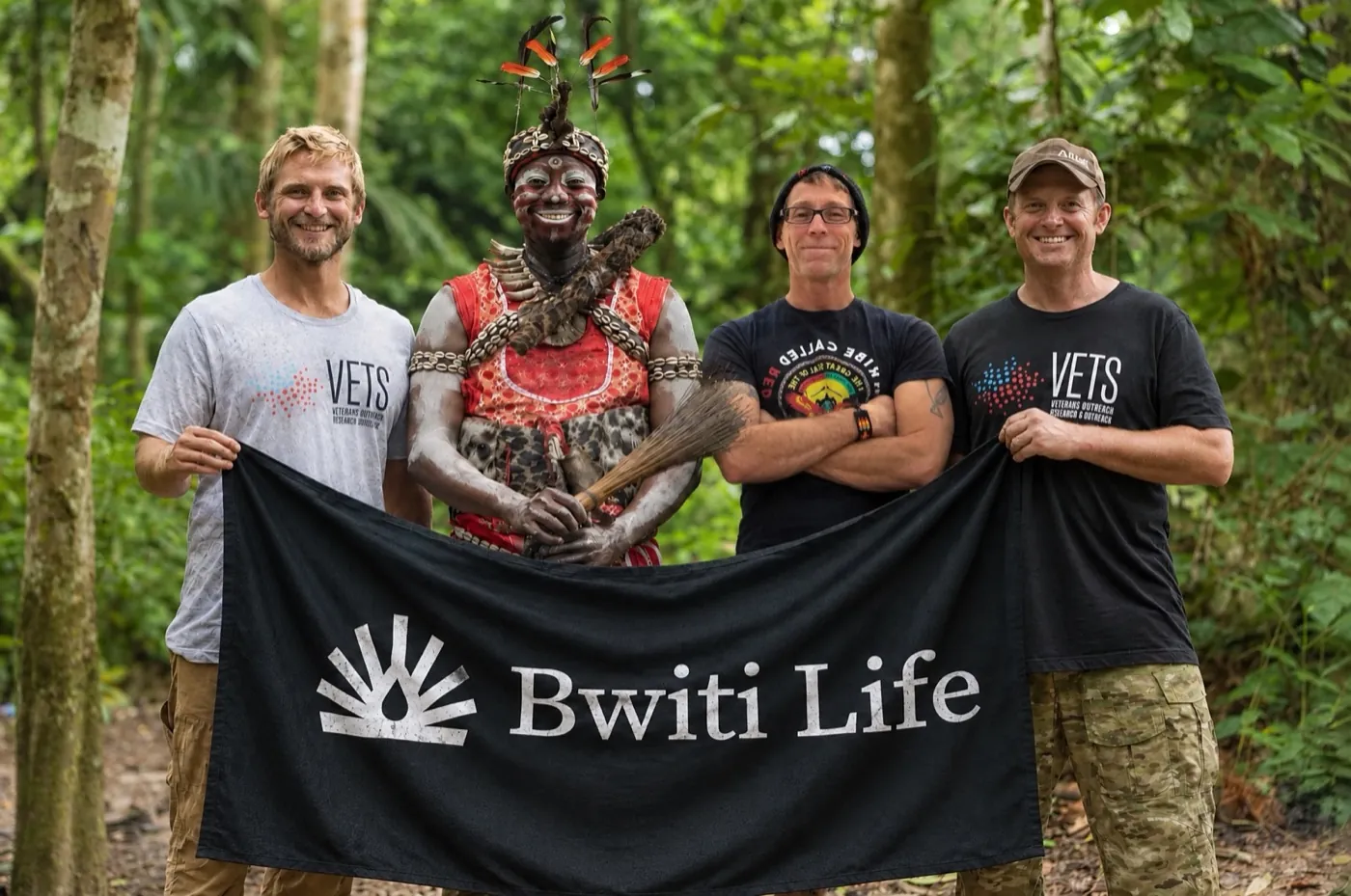
Practitioners initiated in Gabon hold the ceremony. Our physician and psychologist hold the body and the mind, and Lisa is your one contact from first call to flight home. Meet everyone on the team page.


Where the work continues
Integration, in the days at the center and the weeks at home, is where what you saw becomes daily life. Rest, sleep, movement and the rehabilitation you already do all carry on. Please keep your own doctors, therapists and rehabilitation team informed before and after your stay.
Screening, your records, an ECG and bloodwork, the first qEEG, and a call with the psychologist.
The root is given in steps, the practitioner watching you before giving more, the physician in the room all night. See the ceremony.
Rest, a quiet room, the life review, breathwork, time in nature at the cenote.
Weekly integration calls, the second brain map to compare, and a summary for your own doctors if you want one.
Dates
Open retreats and the dedicated veterans' dates. Seven, ten or fourteen days from the same arrival date, eight guests each; full list on the schedule.
We look forward to welcoming you, as you are. Thank you for trusting us with your healing.
Pricing, US dollars
All inclusive from Cancún airport: screening, ceremonies, room, meals, three months of follow-up. All payments are final, see the terms. Full pricing.
Questions about brain injury
No one can promise that, and we will not. Iboga is not a treatment for brain injury. The Stanford study found large improvements in mood, anxiety, trauma symptoms and daily functioning in veterans with brain injury, using purified ibogaine, without a placebo group. It shows promise, not a guarantee.
Tell us, even if it happened once, long ago. Our physician reviews your history, your medicines and your records with you, and with your neurologist where needed, before deciding whether and how the retreat can be planned. Sometimes the answer is a later date.
Never on your own. Declare every medicine and supplement on your health form. Our physician plans any change with you and your prescribing doctor; some medicines need weeks of planning.
No. A qEEG does not diagnose a brain injury on its own and does not replace your scans or your neurologist. It gives you a picture of how your brain works before the retreat, to compare with the map after.
Tell us in advance. The team plans your room, where you lie during the ceremony and how you move around at night, and someone stays beside you through the night.
No. Sport, a car accident, a fall, a blast or years of service: you are welcome on any open date. Veterans and first responders can also choose the dedicated veterans' retreats.
Yes, if your doctor advises it. Tell us early, so we can plan their trip to Cancún and home again with you.

You've carried this long enough. Start with a conversation with our medical team.
