

Why the numbers vary
Success depends on what you count (no use at all, reduced use, no withdrawal at the end of treatment, a better mood score), when you count it (the day you leave, a month later, a year later), and who you count (everyone who came, or only the people who answered the phone). A center that measures withdrawal relief at discharge will report above 80 percent. A center that measures total abstinence at one year, in everyone, will report far less. Both can be honest. Ask which one you are hearing.
What the studies found
- Opioid withdrawal. The best documented effect. Brown and Alper (2018) followed thirty people treated in Mexico: withdrawal scores fell by more than half within about three days, half reported no opioid use in the month after treatment and a third at three months, and drug-use scores stayed lower than before through twelve months, though less markedly. A New Zealand series by Noller and colleagues (2018) followed fourteen people for a year: drug-use scores fell by more than 80 percent in the eight who completed every interview, but 43 to 50 percent still reported some opioid use in the past month at three, six and twelve months, and one person died during treatment. Davis and colleagues (2017) surveyed 88 people: 80 percent said ibogaine drastically reduced or eliminated withdrawal, 41 percent reported more than six months without opioids at the time of the survey, and although 70 percent had relapsed at some point, 48 percent of the sample reported using less than before treatment.
- Alcohol and stimulants. Small studies without a comparison group: a hospital pilot of nine people with alcohol use disorder, a detox series of 89 people dependent on cocaine, and a Brazilian review of 75 people treated with ibogaine and therapy, of whom 61 percent reported being abstinent when contacted. No controlled trials. Relapse is common without follow-up. See the guides on alcohol and cocaine.
- PTSD, depression, anxiety. The 2024 Nature Medicine study on thirty special operations veterans found average reductions of more than 80 percent in disability scores and large drops in PTSD, depression and anxiety at one month, with benefits persisting in follow-up. It was an open-label study without a placebo group.
- What is missing. No randomized, placebo-controlled trial has shown that ibogaine treats any condition. The signal is consistent and encouraging; the proof is not there yet.
-
0%
or more: fall in disability scores one month after treatment
30 special operations veterans · Stanford, Nature Medicine 2024 · open label, no placebo
-
0%
said ibogaine drastically reduced or eliminated opioid withdrawal
88 people surveyed · Davis and colleagues, 2017
-
0%
no opioid use in the month after treatment
30 people treated in Mexico · Brown and Alper, 2018
-
0%
more than six months without opioids at the time of the survey
same 2017 survey
-
0%
relapsed at some point after treatment; 48% of all used less than before
same 2017 survey
-
0
large randomized controlled trials completed, for any indication
the signal is consistent; the proof, in the regulatory sense, is not there yet
The numbers, study by study
The best way to read a success rate is to see the numbers it came from. Here are the two best-documented groups, opioid use and veterans with brain injury, drawn from the papers themselves. Every study used purified ibogaine in a clinic, not root bark in ceremony, and none had a comparison group.
Opioid withdrawal score, before and within about three days after ibogaine
The same treatment, counted four ways
- 80%said withdrawal was eliminated or drastically reduced, in a survey of 88 past patients. Only 88 of the 285 people contacted took part, so those who did well may be over-represented.
- 50%no opioid use in the past 30 days, one month after treatment (Mexico, 30 people)
- 33%the same, at three months, counting everyone who could not be reached as still using
- 30%never used opioids again, in the survey of 88; 70% relapsed at some point, and 48% of the whole group used less than before
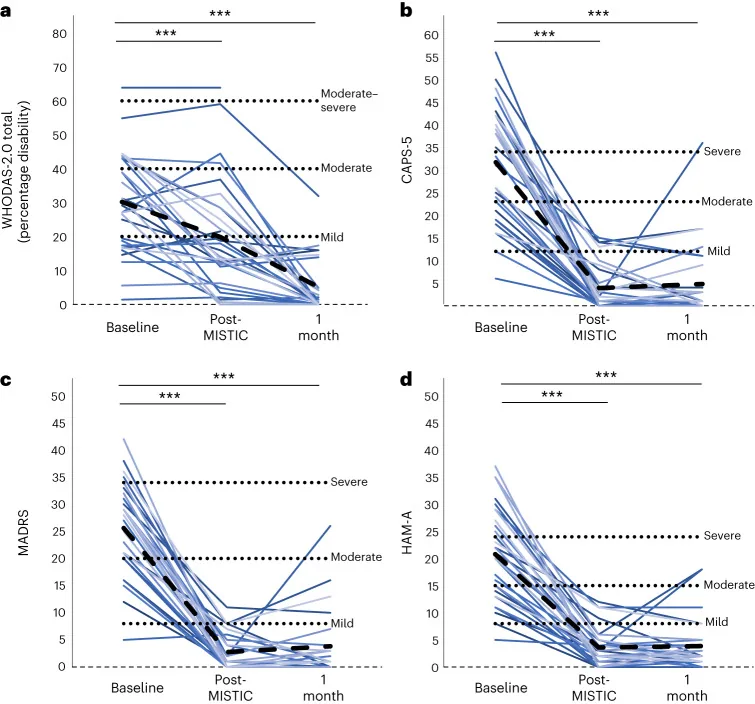
Veterans: average scores before treatment, at one month and at twelve months
- PTSD CAPS-5
- Depression MADRS
- Anxiety HAM-A
- Disability WHODAS
- Before
- 1 month
- 12 months
How to read this
- No comparison group. Everyone was treated and knew it. Hope, the setting and the attention of a retreat can all move these numbers.
- Who answered. Surveys hear most from people who did well. A study that counts missing people as relapsed, as the Mexico study did, gives a lower but more honest figure.
- What else happened. By twelve months, 23 of the 25 veterans had used another psychedelic, most often 5-MeO-DMT, so the long-term result is not ibogaine's alone.
- Small and selected. The largest opioid study with planned follow-up over months had 30 people, and the veterans were all men. None of this tells you your own odds.
Every human study we could verify, with its limits, is on our evidence page: opioids, veterans and what is still unknown.
What "success" looks like in practice
For dependence: getting through withdrawal without agony, then a window of weeks in which craving is absent or faint, then the work of rebuilding a life so that the window becomes a life. Relapse in that period is common and is not the end; it is a reason to call. For trauma, burnout and grief: a night that shows the material with distance, followed by months in which sleep, mood and reactivity measurably improve for most, and the changes people make with that clarity.
How Bwiti Life measures
We measure before and after: sleep, heart-rate variability, resting heart rate and other markers from wearables and bloodwork, and validated questionnaires for mood, anxiety and craving. We follow every guest for three months, and we tell you what we see. We do not publish a headline percentage, because we would have to pick which one, and the honest ones make bad marketing. Ask us on the discovery call and we will show you the data we have.
How to read a provider's claim
Ask what was counted, when, and in whom. Ask whether people who did not answer follow-up are in the denominator. Ask whether they follow anyone at all. A provider quoting 90 percent without a definition is quoting withdrawal relief at discharge, or quoting nothing.
Questions people ask
What is the success rate at Bwiti Life?
We do not publish a single number. We measure sleep, heart-rate variability, mood, anxiety and craving before and after, follow every guest for three months, and share the results with each guest and, in aggregate, on request.
Is one treatment enough?
For many, one retreat and three months of follow-up produce the change they came for. Some return a year or more later for a different question. Repeated flood doses close together are not how the medicine is used.
Does the tradition change the outcome?
We think the container, the life review and the days of processing change what people do with the experience, which is what determines the outcome. It has not been measured in a trial; it is what our guests tell us, and what we see in the follow-up.
Why do people relapse after ibogaine?
Because the medicine interrupts the dependence and does not change the life around it. The people, places and stresses that drove the use are waiting at home. That is what the three months after are for.
Keep reading
 Mind and bodyHow iboga worksNoribogaine, receptors, neuroplasticity, the heart, and the key studies.19 min read
 The programAddiction and detox programMedical stabilization, Bwiti ceremonies, a physician on site, and three months of care.20 min read
 The programFor veterans and first respondersA retreat held by a former Navy SEAL, a small group, a physician on site.13 min read
 The programSafety and medical protocolThe risks, the screening, what happens around your mat, and who we decline.13 min read