Mind and body · OCD
What guests often describe after the retreat is a little more room around the thoughts, and a clearer view of their life. Since 2012 we have held a medically supervised iboga retreat on the Mayan Riviera near Cancun, Mexico, where a traditional Missoko Bwiti ceremony is paired with therapy and three months of follow-up at home. Exposure and response prevention (ERP) is the first-line treatment for OCD, and nothing we offer replaces it. If rituals have taken hours of your day, you are not alone.
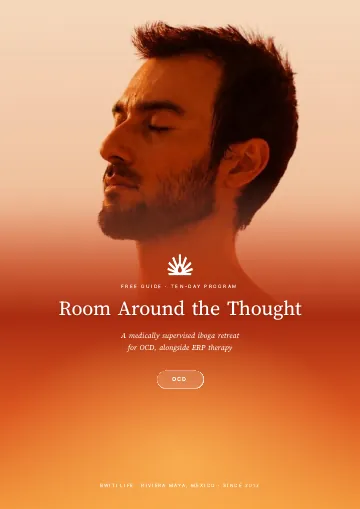
Free guide · PDF
Room Around the Thought
OCD: the ceremony, the numbers, the research and how to prepare.
How it works
No study, trial or case report has tested iboga or ibogaine for OCD, so we never promise a change in the condition itself. What we offer, from our experience since 2012 with 7,677 guests, is a supervised opening alongside ERP: a long night of reflection, held by a tradition and a medical team, then three months of work at home.
Before you travel, our physician reviews your health and your medicines, which for OCD are often high-dose. On the night she and the medical team are in the room, and the practitioner gives the medicine in steps.
In the Missoko Bwiti tradition the ceremony begins with the person, not the symptom. Guests often describe a long, lucid review of their life, with the doubts and fears seen as part of a bigger picture. Belief is not required.
Screening with our psychologist, the ceremonies, a life review the next day, then three months of integration calls. With your consent we write to your ERP therapist, and we encourage you to keep that work going.
Who holds it
Michael and Cory open and hold the ceremony; Tania, our psychologist with close to a decade at Mexico's National Institute of Psychiatry, screens for what iboga cannot hold and carries the integration; Dr Villarreal keeps the body safe.


Safety
OCD medicines are the main thing to plan for, and the screening is thorough.
Some SSRIs and clomipramine change how the body clears ibogaine, and fluoxetine stays in the body a long time. Tapering is your prescriber's decision, planned well ahead with our physician. Stopping suddenly can bring withdrawal and relapse, so never stop on your own.
Depression, thoughts of suicide, bipolar disorder, psychosis, tics and eating disorders, now or in the past. If you have thoughts of ending your life, call or text 988 in the US or Canada today.
Iboga affects heart rhythm, so every guest has an ECG and a medical screening before travel; read how we protect your heart. Guests must be 18 or older.
Who it is for
Adults with OCD who are in ERP therapy, have done it, or are ready to start, and who want a long, honest look at their life. People willing to be honest in screening and to keep working with their therapist after.
Active psychosis or recent mania, an unstable eating disorder, acute suicidality, a medication that cannot be tapered in time, pregnancy, or a heart condition. The psychologist and the physician decide together, and sometimes the answer is a later date.
Why it is hard
OCD means obsessions, which are intrusive, unwanted thoughts, urges or images, and compulsions, the rituals or mental acts done to ease the distress. Common themes are contamination, harm, symmetry and taboo thoughts. Having a thought does not mean you want to act on it. About 1.2% of US adults have OCD in a given year, and half of them are seriously impaired by it.
Each ritual lowers anxiety for a moment, which teaches the brain that it worked, so the urge comes back stronger. Avoidance, reassurance seeking and family members helping with rituals keep the loop going. Because rituals can be hidden or silent, the International OCD Foundation estimates that people wait years for effective treatment.
Exposure and response prevention (ERP) is the first-line treatment, with strong evidence from many randomized trials. It is a form of cognitive behavioral therapy. With a trained therapist you face the thought, the object or the situation step by step, then let the anxiety rise and fall without the ritual. Trying to push thoughts away tends to backfire; ERP teaches you to let a thought be there without answering it.
SSRIs such as fluoxetine, fluvoxamine, sertraline, paroxetine and escitalopram are also first-line, often at higher doses for 8 to 12 weeks. Clomipramine works too, usually as a second choice. The UK's NICE guidelines recommend ERP, an SSRI or both, in steps. When OCD does not respond, options include adding an antipsychotic, deep TMS, cleared by the FDA in 2018 as an add-on for adults, and for severe cases deep brain stimulation.
Find an ERP therapist through the International OCD Foundation directory, or free self-help tools from Anxiety Canada.
About psilocybin. A 2006 study of 9 patients reported symptom drops, and larger trials are under way, but no psychedelic is approved for OCD. Psilocybin results do not carry over to iboga, which is a different medicine with different risks.
Dates
Open retreats and the dedicated veterans' dates. Eight guests each; full list on the schedule.
You are not your thoughts. Come as you are, doubts included; we will hold the night with you.
Pricing, US dollars
All inclusive from Cancún airport: screening, ceremonies, room, meals, three months of follow-up. All payments are final, see the terms. Full pricing.
Questions about OCD
Obsessive-compulsive disorder is unwanted, intrusive thoughts, urges or images, plus rituals or mental acts done to ease the distress they cause. It is diagnosed when this takes a lot of time, often over an hour a day, or causes real distress. It is not tidiness or a quirk.
About 1.2% of US adults in a given year, 1.8% of women and 0.5% of men, and 2.3% at some point in life, according to the US National Institute of Mental Health.
Exposure and response prevention therapy and SSRIs, alone or together. Both are first-line, with strong evidence. ERP is where we suggest you start, and it stays the base of the work after any retreat.
Trying to suppress them usually makes them louder. ERP teaches a different skill: allowing the thought to be there without doing the ritual, until the anxiety settles on its own. It takes practice, with a trained therapist.
Usually not; it tends to be long-lasting. The hopeful part is that many people improve greatly with treatment, especially ERP, an SSRI or both.
Only small early studies exist, such as one of 9 patients in 2006, and larger trials are still running. Psilocybin is not an approved treatment for OCD, and its results do not apply to iboga.
It used to be grouped with them. The DSM-5 moved OCD into its own chapter, the obsessive-compulsive and related disorders, together with body dysmorphia, hair pulling and skin picking.
Shame, rituals that happen silently in the mind, and too few trained clinicians all play a part. The International OCD Foundation estimates that people wait years between the start of OCD and effective treatment.
No. Having a thought does not mean you want to act on it. The distress you feel about the thought is part of OCD, and a therapist trained in ERP will have heard it before.
No study, trial or case report has tested iboga or ibogaine for OCD, so we do not claim it does. We offer a supervised night of reflection inside a tradition, with therapy and follow-up, as a complement to ERP.
Possibly, with a plan made well ahead by your prescriber and our physician. Some of these medicines change how ibogaine is cleared. Never stop on your own: sudden stopping can bring withdrawal and relapse.
No. Keep going with your ERP therapist before and after the retreat. With your consent we send them a summary, and integration calls can include them.
Yes. Guests must be 18 or older. For a young person with OCD, a therapist trained in ERP is the right first call.

You've carried this long enough. Start with a conversation with our medical team.
