Founders, executives, high performers
A seven- to fourteen-day medically supervised reset on the Mayan Riviera near Cancun, Mexico for people whose bodies have started sending invoices: sleep that does not restore, a mind that will not stop, decisions that cost more every quarter. Measured before, during and after.
Free guide · PDF
Back on Solid Ground
Burnout: the ceremony, the numbers, the research and how to prepare.
What burnout is
The World Health Organization describes burnout in its International Classification of Diseases, ICD-11, as a syndrome that comes from chronic workplace stress that has not been successfully managed. It lists it as an occupational phenomenon, not as a medical condition, and it uses the word only for work, not for the rest of life.
That matters for you in two ways. First, burnout is real and it has a shape. Second, it often travels with things that are medical conditions, like depression, anxiety, insomnia or a drinking problem, and those deserve their own care. Part of our screening is telling the two apart.
You are tired in a way that sleep and a weekend no longer fix. You wake up already behind. Caffeine got you through the morning; now it barely gets you to noon.
The company you built starts to feel like someone else's problem. You dread the calendar, snap at people you hired because you liked them, and stop caring about wins that once mattered.
Decisions take longer. You reread the same email. You work more hours to produce what used to take half the time, and you start to doubt you are still good at this.
Founders usually call us about the body first: sleep that does not restore, a racing heart at 3 a.m., headaches, a stomach that is always tight, colds that hang on, a drink that became two. A review of 36 prospective studies found that burnout predicted later physical problems, including type 2 diabetes, high cholesterol, coronary heart disease, prolonged fatigue, headaches and stomach problems. It also predicted insomnia, depressive symptoms and the use of psychotropic and antidepressant medicines.
Anyone who works can burn out, but founders carry a particular load: no boss to set limits, money and identity tied together, and the feeling that everyone depends on you. In a survey of 242 entrepreneurs, 72% were affected directly or indirectly by mental health differences. Entrepreneurs reported more depression (30%), ADHD (29%) and substance use problems (12%) than the comparison group. That is a self-report survey, not a diagnosis, but it matches what we hear on intake calls.
Why it keeps going
Researchers Christina Maslach and Michael Leiter describe burnout as a mismatch between a person and their work in six areas: workload, control, reward, community, fairness and values. For a founder, several of those are out of balance at once. The work never ends, control feels out of reach on bad days, and the values that made you start can get lost in the fundraising.
So you push harder, because pushing has always worked. You borrow from sleep. A stimulant or a fourth coffee gets you through the afternoon, a drink or two takes the edge off at night, and a sleeping pill, when you need one, buys a few hours. Each piece makes sense on its own. Together they turn into a loop, and the loop is what keeps burnout going after the crisis that started it has passed.
This is not a moral failing. It is what a capable person does when the only tool they trust is effort. Breaking the loop usually takes two things: a real stop, and a different plan for the work you go back to.
How it works
The same loop, every quarter.
Too much to do, push harder, sleep worse, less gets done.
In the ceremony, many guests describe stepping outside the loop and seeing what has been driving it.
Therapy and three months of follow-up help the new path hold.
Integration calls, new habits, support at home.
Why founders come
Burnout is not a mindset problem; it shows up in cortisol, sleep architecture, heart-rate variability and inflammation. We measure those first. Then the ceremony offers what a week off rarely does: a full stop, and a long look at the loop from outside it.
Blood panel with more than 110 markers, ECG review, sleep and HRV from your wearable. The physician reads it with you before you fly. Most founders have never seen their own baseline; it changes how seriously they take the rest.
Iboga keeps you lucid while the mind reviews the last years at speed: decisions, relationships, the reasons you started. Guests describe coming out with a strange, quiet clarity about what matters and what was noise.
Four calls over three months with the medical team or the psychologist, more if you need them, wearable data reviewed against your baseline, and a living plan for sleep, training, alcohol and calendar. The improvement is tracked, not hoped for.
What the research says
We will say it plainly: there is no research on iboga or ibogaine for burnout, in people or in animals. Iboga is not an approved treatment for burnout or for anything else. Anyone who promises you a cure is selling something. What exists is research on nearby questions, and each piece has limits you should know.
A Stanford study followed 30 male special operations veterans with mostly mild traumatic brain injuries who received ibogaine with magnesium, alongside other care. One month later, their scores for disability, PTSD, depression and anxiety had improved, with no unexpected or serious adverse events. It was open-label, with no comparison group, and it used purified ibogaine, not root bark. It says nothing direct about burnout.
In rats, ibogaine reduced alcohol drinking, including in a relapse model, and raised GDNF, a growth factor that supports dopamine neurons in the brain's reward system. That is one reason people who drink to come down from work are curious about iboga. Rat studies do not tell us what happens in a tired founder.
In rats, ibogaine and its metabolite noribogaine kept the animals awake and suppressed dream sleep for hours. Guests describe little sleep on the ceremony night itself, then often a long, deep rest on the processing day. We plan the week around that, and we do not promise better sleep as a result.
In a Dutch hospital study of 14 people with opioid dependence given ibogaine, the heart's QTc interval lengthened in every case and half passed 500 milliseconds, a level that raises the risk of a dangerous rhythm. The change was reversible, but it is why every guest has an ECG before travel and heart monitoring through each ceremony. Read how we protect your heart.
The evidence points mostly at the work itself: a workload you can carry, real control over your time, people around you, and a job that matches your values. Treating depression, anxiety or insomnia when they are there also matters, with your own doctor. A retreat cannot change your cap table or your board. What it can give is distance, a clear look at your own patterns, and a plan you build with a team that checks in with you afterward.
Separate from the research, founders who come to us often describe the ceremony night as a long, lucid review of the last years: the deals, the people, the moment they stopped enjoying it. Many describe a quiet clarity about what matters, and a body that finally lets go in the days after. That is their experience, not a measured result, and it is not the same for everyone.
Who holds it
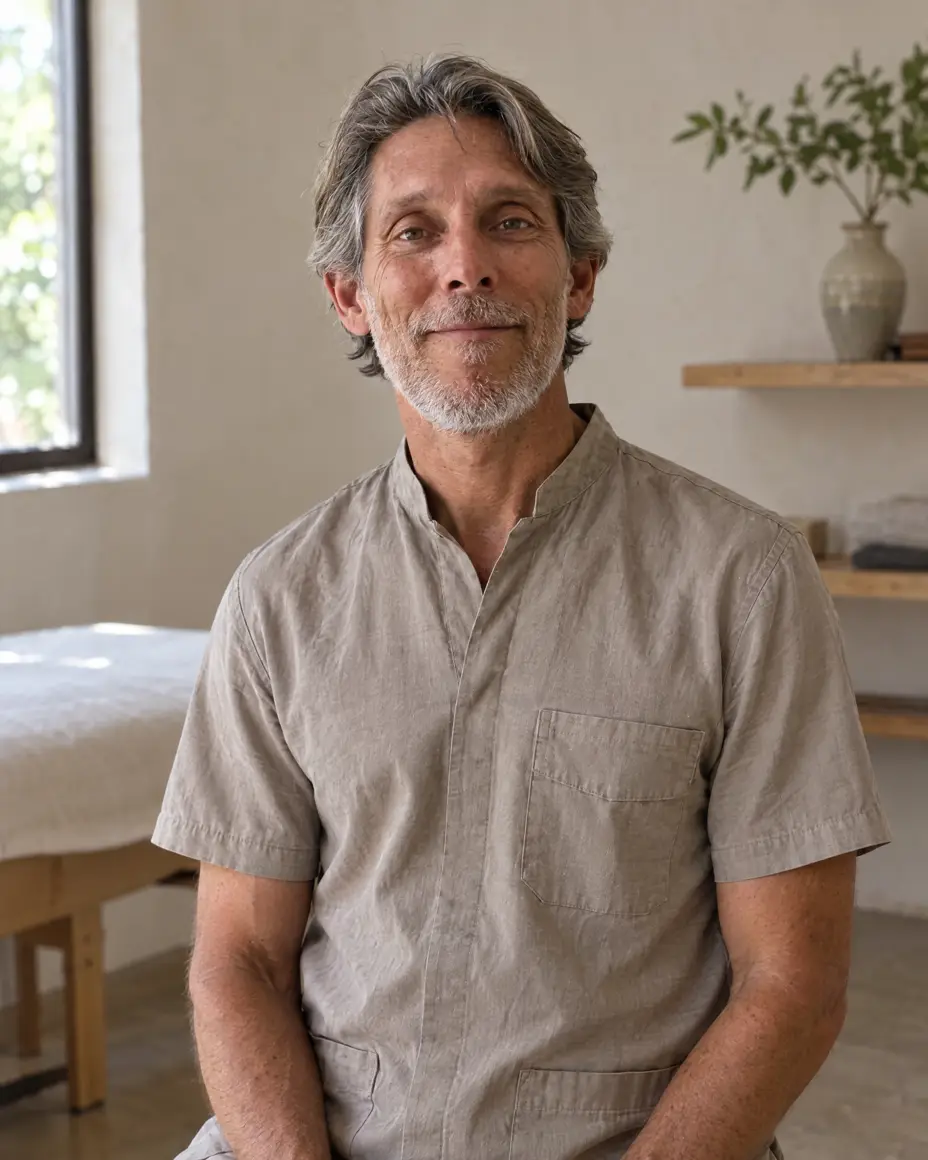
The ceremony is held by practitioners trained in Gabon; the safety is held by a physician who stays in the room; the follow-up is held by a psychologist with a decade of clinical practice. Nothing is outsourced.



How it unfolds
Most founders choose seven days with two ceremonies, or ten days with three when they can. Phones stay on until the first ceremony, then off until the last integration day.
Discovery call, questionnaire, bloodwork at a lab near you, ECG review. The physician calls you with the results. Preparation guidelines for diet, alcohol and stimulants.
Cancún pick-up by Michael or another practitioner, your own room, vitals, a walk through the week, and the first fire talk in the evening.
The night ceremony, a day of rest with the medical team, a day at the cenote with the psychologist and your notebook. Then again.
Four calls over three months, more if you need them, your data compared to baseline at four, eight and twelve weeks, and honest conversations about what you keep changing.
Who it is for
Adults 18 and over who are worn down by work and ready to look at why: founders, executives, partners in firms, doctors, anyone who has been running on effort for years. People who can block seven to fourteen days, who will tell us the truth about what they take, and who want to change something when they get home, not just recover enough to do it all again.
Active psychosis or recent mania, acute suicidal thoughts, an unstable eating disorder, a medicine that cannot be safely tapered in time, or pregnancy. A heart condition needs a careful look first. If you are in the middle of a crisis that needs you next week, such as a sale, a lawsuit or a layoff, we will usually suggest a later date. The physician and the psychologist decide together, and sometimes the answer is not yet.
If you have thoughts of ending your life, call or text 988 in the United States or Canada, at any hour. A retreat can wait; you come first.
Day by day
The rhythm is the same for every guest: arrival, then each ceremony night followed by a processing day and an integration day. Ten and fourteen days add a third, sometimes a fourth, ceremony. Your own schedule is set with the team.
Pick-up at Cancún airport, twenty minutes to the center. Intake with the physician, vitals, your room. The first fire talk in the evening. Nothing is given on day one. Send your last handover emails tonight.
A quiet day, a light meal, a check of your vitals. At night, around the fire, you say your intention out loud. The practitioner gives the root in steps and watches you all night; the physician is in the room. The phone goes in the drawer.
You rest in your room, unsteady on your feet, with water, fruit and the team checking on you. Many guests sleep deeply. Some write. No one asks you to perform anything.
A swim at the cenote, then time with the practitioner and the psychologist to put the night into words. What did you see about the work, the people, the pace? Write it down while it is fresh.
Often quieter and more personal than the first. Guests describe going past the company to what sits under it: the parent who only praised results, the fear of being ordinary, the grief the speed kept away.
Processing, then a last integration day. You leave with a written plan for sleep, alcohol, training and your calendar, the first integration call booked, and a ride back to the airport.
Preparation and safety
Burnout rarely comes alone. By the time founders call us, many are using something to get through the day and something else to get through the night. None of that disqualifies you. It just has to be on the table, because iboga acts on the heart and on the brain's chemistry, and several common medicines change how the body handles it.
Never stop or change a medicine on your own. Some medicines are dangerous to stop suddenly. Our physician plans every change with you and your prescribing doctor, sometimes weeks before travel.
Prescribed ADHD medicines, modafinil, pills from a friend. Stimulants raise heart rate and blood pressure, and they are stopped before the ceremony on the physician's plan, coordinated with your prescriber. Read stimulants and iboga.
How much you really drink, most nights. Heavy daily drinkers should not stop abruptly on their own, because alcohol withdrawal can be dangerous. The team plans the step-down with you. Read alcohol and iboga.
Zolpidem and similar sleep medicines carry an FDA boxed warning for sleepwalking, sleep driving and other activities done while not fully awake. Benzodiazepines can cause seizures if stopped suddenly. Both need a planned taper. Read benzodiazepines and iboga.
Ibogaine is cleared by the liver enzyme CYP2D6. Some antidepressants block it: in one study, paroxetine roughly doubled exposure to the active drug. Bupropion also blocks it. Every antidepressant is reviewed with your prescriber before anything changes.
A blood panel and a recent ECG with its report before you travel. Years of high blood pressure, palpitations or fainting must be mentioned. See the medical protocol.
Name who decides while you are away. Tell your co-founder or board the dates. Clear the week after, not just the week of. The retreat works better when nothing is waiting to pull you back.
For partners and co-founders
Partners often see burnout before the founder does: the short temper, the drinking, the 2 a.m. laptop. You are welcome on the discovery call. The decision has to be theirs, though. Someone sent by a spouse or a board against their will rarely gets much from the week, and we will say so.
While they are away, the phone is off. The team can reach you in an emergency, and with their consent we can tell you they arrived safely. When they come back, expect a few slower weeks and a person who may want to change some things, including how the household runs.
Say what you see, without a diagnosis. Ask what they want to change.
Ask every question, side by side. Book a discovery call.
Help keep the first week back light, and stay part of the plan.
After the retreat
The week opens a window. What you do with your calendar in the following three months decides whether it stays open. That is why follow-up is part of the price, not an extra.
No board meeting, no fundraising call, no all-nighter. Short days, early nights, daylight, food at regular times. Many guests feel clear and light. Some feel raw. Both are normal, and both pass.
Integration calls with the psychologist or the medical team, your wearable data compared with your baseline, and honest talk about what is holding and what is slipping. With your consent, we can send a summary to your own doctor or therapist.
The old hours creep back, the drink returns, a bad quarter hits. Call us early, not after a month of silence. We look at what changed, adjust the plan, and point you to local care if you need more than calls. After the three months, alumni calls are available.
Dates
Eight guests per retreat. Arrival dates below; the full list is on the schedule.
We look forward to welcoming you, as you are. Thank you for trusting us with your healing.
Pricing, US dollars
All inclusive from Cancún airport, including the diagnostic interpretation and three months of follow-up. Laboratory tests before travel are paid separately. Apart from the deposit refunded when we cannot clear you, payments are final, see the terms. Full pricing.
Questions founders ask
No, and that is the point. You keep your phone until the first ceremony for handovers, then it goes in a drawer until the last integration day. Guests who tried to keep one foot in the office got less from the week; block it like surgery.
Most guests fly home clear-headed and sleep unusually well for the first two weeks. Plan a light first week back: no board meetings, no fundraising calls. The three months of follow-up exist because the changes are made at home, not at the center.
It is in a class of its own. You remain aware of the room and of yourself, there is no visual overload, and it is not euphoric. The experience is long, twelve hours or more, introspective and physically demanding, which is why the medical supervision matters.
A blood panel of more than 110 markers (metabolic, hormonal, inflammatory, cardiac, nutritional), an ECG review, and your sleep and heart-rate variability history from your wearable if you have one. The physician interprets it with you; the tests themselves are done at a lab near you before travel.
Yes, if they apply and are cleared like every guest. Couples take a private room. Partners who do not take part in the ceremonies cannot stay at the center during the retreat.
Not exactly. The World Health Organization lists burnout in ICD-11 as an occupational phenomenon: a syndrome from chronic work stress that has not been managed, marked by exhaustion, mental distance from the job and reduced effectiveness. It is not classified as a medical condition. Depression, anxiety and insomnia often come with it, and those are diagnosed and treated in their own right.
No one can honestly promise that. No study has tested iboga or ibogaine for burnout, and iboga is not an approved treatment. What we offer is a supervised stop, a long night of looking at your own patterns, and three months of follow-up to help the changes hold. What guests describe is clarity and rest, not a cure.
Stimulants are stopped before the ceremony, on a plan our physician makes with your prescriber, because they raise heart rate and blood pressure and interact with iboga. Never stop on your own. If you have ADHD, we help you plan how to manage it afterward with your own doctor.
Often, yes, with a plan. Tell us honestly how much you drink. If you drink heavily every day, do not stop abruptly on your own, because withdrawal can be dangerous; the team plans the step-down with you before travel, and sometimes adds medical detox days.
A wellness retreat rests the body; a sabbatical gives you time. Both help, and neither is a bad idea. This is different: a medical screening before you come, a traditional Missoko Bwiti ceremony under physician supervision, and three months of follow-up. It is more demanding, and it is not right for everyone.
Sources

You've carried this long enough. Start with a conversation with our medical team.