
 Markers
- 78
- Optimal
- 12
- Borderline
- 9
- Needs work
Medical protocol · Digital Twin
Iboga's benefits should be proven, not promised. We measure your biomarkers before the retreat and again three months after, and in our experience the improvement is significant. Follow the protocol and see it in your own numbers.
 HIPAA-aligned medical data: encrypted and stored on AWS under a HIPAA Business Associate Agreement

 Protein
120daily
 Carbs
Carbs340daily
 Biological Age
32years
 Stress level
24 Low
 Brain screening
 Sleep quality
 78
78
Excellent
All markers are clear
 Markers
12µmol/L
 HRV Trend
Proof, not promise
Most of what is said about iboga is testimony. We wanted something you can check. So every guest is measured twice with the same tests, weeks before the retreat and three months after it, and the two sets of numbers are compared side by side. The medicine, the ceremony and the tradition are the intervention; the biomarkers are the evidence.
A blood panel of 110+ markers, a 12-lead ECG and short questionnaires on mood, anxiety, stress and craving. Several of these markers also guide the physician’s safety checks in ceremony. A wearable (Apple Health, Oura, Whoop, Garmin and others) is optional; the blood panel and ECG are not. The physician reads your starting point with you.
Vitals and cardiac telemetry through every ceremony, daily measurements between them. Nothing here is used to prove anything; it is used to keep you safe. The proof comes later.
The same blood panel, the same questionnaires, and, if you wear a tracker, its data reviewed at four, eight and twelve weeks. Same tests, same lab where possible, same conditions, so that the comparison means something.
Your two sets of numbers side by side, marker by marker, with the physician. What moved, what did not, and what to do next. Whatever the result, you see it.
What we have seen
Across the guests we have followed, the markers that move most consistently between the baseline and the three-month measurement are the ones that reflect a nervous system that has stood down and a body that sleeps: heart-rate variability, resting heart rate, deep sleep, morning cortisol, blood pressure and inflammatory markers such as hs-CRP, along with the mood, anxiety and craving scores. Weight, blood sugar and lipids follow when the habits change. The before-and-after cards on our continued care section show what that looks like.
We do not publish a headline percentage. Our sample is small, it is not a controlled trial, and every body starts from a different place. What we can say is that the direction of change has been consistent, and that we show every guest their own numbers, including the ones that did not move.
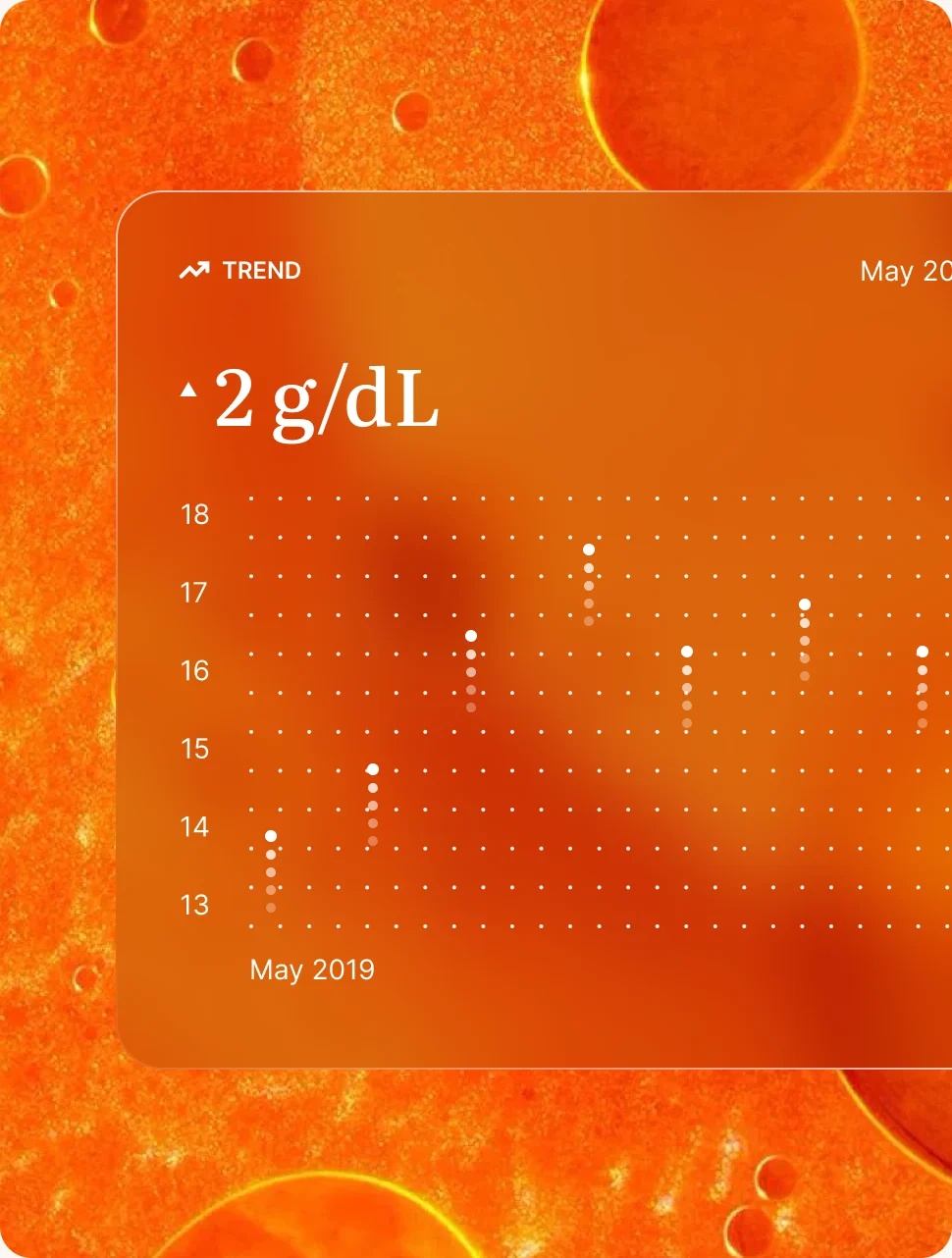
The signature of a body no longer bracing. For guests who wear a tracker, measured continuously, so the trend is visible week by week; for the others, resting heart rate and blood pressure at baseline and at three months.
Blood and vitals, taken under the same conditions before and after. These move more slowly and are the ones that tell you whether the change is holding.
Validated questionnaires, the same ones used in clinical research, filled in before you travel and at four, eight and twelve weeks.
These follow the habits you build in the three months after. They are where the continuing care earns its keep.
Test it yourself
Anyone can run this experiment on their own body. The protocol is simple, and we help with every step for our guests: the lab order, the interpretation, the optional wearable export, the comparison at three months.
Order the blood panel and the ECG through your doctor or a lab near you, two to four weeks before your retreat, and fill in the questionnaires we send. Optional: wear a tracker every night for those weeks and share the export (Apple Health, Withings, Oura, Whoop, Garmin, Fitbit).
Seven, ten or fourteen days on the Mayan Riviera near Cancun, Mexico, in the tradition, with the medical team in the room.
Fill in the questionnaires at four, eight and twelve weeks, and keep the tracker on if you have one. Live your life; the point is to measure the life, not a retreat bubble.
The same panel, the same lab, the same time of day. Send us the results, and sit down with the physician for the comparison. Then decide for yourself what iboga did.
Bwiti Life Protocol
Ancestral ceremony, clinical longevity science, one structured path over three months. Heal your soul, transform your body, and see it in your data.
Blood work, 12-lead ECG and daily vitals: the tests we require, read by a physician before you are cleared.

Ancestral ceremonies under 24/7 medical supervision.

 180
Days in a row
180
Days in a row
Three months by your side, making your transformation last.
 Phase 1
Diagnostic
Phase 1
Diagnostic
 Phase 2
Retreat
Phase 2
Retreat
 Phase 3
Continued care
Phase 3
Continued care
Diagnostic
We map who you actually are. 110+ biomarkers, your brain, your heart, your sleep. One honest starting point, so every change afterward is a fact, not a feeling.
Not a report you read once. Every signal feeds one living model of you. Your twin re-computes every marker from your real data. See where you're heading, and what changes if you act.
110+ biomarkers across 11 body systems, drawn before you travel and read by a physician: hormones, inflammation, metabolic and cardiac markers, micronutrients. Not a range on a lab sheet, but where you stand and what it means for the ceremony and for the months after.
At the center, the same measurements every day: blood pressure, heart rate and heart-rate variability, weight and body composition, a six-lead ECG. The same measure taken again and again turns a snapshot into a trend.
A qEEG brain map before and after the retreat shows how your brain actually works: where activity is over- or under-active, how it regulates stress and sleep. Your practitioners read it, and so do you.
Markers
 Brain screeningKidney screening
 Liver screening
 Beats per minute
 ECG
ECGContinued care
What happens on the Mayan Riviera near Cancun, Mexico shouldn't stay a memory. For three months, medical follow-up turns what you feel into what your data shows.
Nutrition, training and supplementation, re-tuned to your data week after week. You even learn to cook for your 11 body systems, an education you keep for life.
Every week for three months, a call with your medical team or counselor: your wearable data, your goals, what to adjust. Video or audio, at the time you choose.
Why the numbers move: it starts in ceremony, not in a spreadsheet.
You see your patterns from the outside: where the stress comes from, what you have been running from, and that you are worth taking care of.
Toxic habits lose their grip: alcohol, sugar, overwork, the phone at 2 am. Sleep, movement, real food and self-respect take their place, with a plan and weekly calls.
Within three months the body shows it: stress down, heart-rate variability up, weight and cholesterol down, deeper sleep. You feel it first; then you can measure it.
Before the retreat
 Stress level

 78
High
78
High
 Biological Age
47 years
Heart rate variability32 ms
Low resilience
 Weight
94 kg
Above target
 LDL cholesterol
165 mg/dL
High
Resting heart rate74 bpm
Elevated
Sleep5.4 hours
Fragmented
Blood pressure138/88 mmHg
Elevated
Inflammation (hs-CRP)3.8 mg/L
High
VO₂ max31 mL/kg/min
Below average
HbA1c5.9 %
Prediabetic range
Fasting glucose104 mg/dL
Elevated
Triglycerides190 mg/dL
High
Body fat28 %
Above target
Deep sleep48 min a night
Short
Alcohol12 drinks a week
Daily habit
Morning cortisol22 µg/dL
High
Vitamin D22 ng/mL
Insufficient
Grip strength34 kg
Below age norm
Steps a day4,200 steps
Sedentary
Waist98 cm
Above risk line
After three months
Stress level
24
Low
Biological Age
39 years
Heart rate variability68 ms
+112%
Weight86 kg
8 kg lighter
LDL cholesterol118 mg/dL
Down 28%
Resting heart rate58 bpm
16 bpm lower
Sleep7.6 hours
+2.2 hours a night
Blood pressure121/78 mmHg
Normal
Inflammation (hs-CRP)1.1 mg/L
Low
VO₂ max39 mL/kg/min
Fitness age 8 years younger
HbA1c5.3 %
Normal
Fasting glucose88 mg/dL
Optimal
Triglycerides110 mg/dL
Down 42%
Body fat21 %
7 points lower
Deep sleep92 min a night
Nearly doubled
Alcohol0 drinks a week
Free of it
Morning cortisol14 µg/dL
Optimal
Vitamin D41 ng/mL
Optimal
Grip strength41 kg
Above age norm
Steps a day9,800 steps
Active
Waist89 cm
9 cm less
Example Illustrative values from one guest profile, not a promise. Results vary from person to person.
Illustrative values from a typical guest profile. Your own baseline and progress come from your wearable and lab data.

You've carried this long enough. Start with a conversation with our medical team.


