Main character syndrome
Since 2012 we have held a medically supervised iboga retreat on the Mayan Riviera near Cancun, Mexico. A traditional Missoko Bwiti ceremony is paired with a psychologist, then three months of follow-up at home. Guests who feel trapped in their own story often describe a night that widens the frame, with room for the people around them. Main character syndrome is internet slang, not a medical diagnosis, and you do not need one to talk to us.
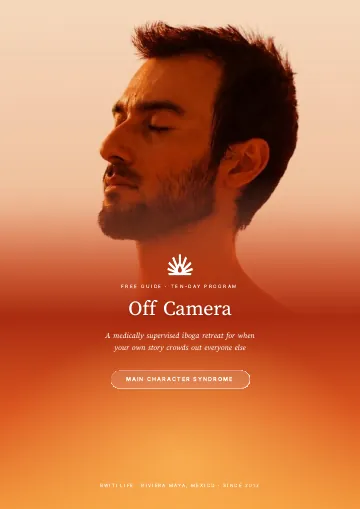
Free guide · PDF
Off Camera
Main character syndrome: the ceremony, the numbers, the research and how to prepare.
How it works
Seeing your life as a story is human. The trouble starts when the story leaves no room for anyone else, or when it props up a sense of self that feels thin underneath. We take that seriously, without judgment.
No study has tested iboga or ibogaine for main character syndrome or for narcissism, and we do not claim it dissolves the ego. What follows comes from our experience with 7,677 guests since 2012: a supervised opening alongside therapy, never a replacement for it.
Every guest has a medical screening and bloodwork before travel. The physician reviews every medicine, then stays in the room through the ceremony.
The Missoko Bwiti tradition of Gabon is not filmed or posted, which protects your privacy and that of every other guest. Many guests describe seeing their life, and the people in it, from the outside.
Tania, our psychologist, prepares you and works with you the day after. Three months of integration calls follow at home, focused on identity and on the people close to you.
How iboga acts on the brain
Brain researchers link self-focused thinking to the default mode network. One early ibogaine study (Shinozuka et al., 2026, not yet peer-reviewed) found no change in that network at rest, yet one of its shifting states lasted longer, linked to mystical experience and to improvement. In theory, that may relate to how guests describe seeing themselves differently. It is not evidence that ibogaine reduces self-focus.
People also describe a dream-like waking state full of memories, and animal studies suggest effects on plasticity. In the strongest human study so far (Cherian et al., Nature Medicine, 2024), 30 veterans reported large drops in depression and anxiety, in a study without a control group. None of this has been tested for main character syndrome. More on how iboga works.
What we have seen since 2012
Since 2012, with 7,677 guests, we have seen a traditional treatment help people with this kind of struggle, sometimes profoundly and lastingly. Some arrived exhausted by performing their life online, others unsure who they were when no one was watching.
Afterwards guests describe noticing other people more, listening longer, feeling less need to be seen. Some say the story they told about themselves loosened, and something quieter took its place. Others changed less. This is our experience, not a clinical study.
Who holds it
Michael and Cory open and hold the ceremony. Tania, our psychologist with close to a decade at Mexico's National Institute of Psychiatry, screens for what iboga cannot hold and carries the integration. Dr Villarreal keeps the body safe, in the room all night.


Safety
A strong sense of being special can sometimes be a sign of hypomania or mania, so the psychologist screens for bipolar disorder. Mania has followed unsupervised ibogaine use in three reported cases. She also screens for depression, substance use and personality patterns that need their own care.
Our physician reviews every medicine with your prescribing doctor; never stop one on your own. Guests must be 18 or over. Read how we protect your heart.
Who it is for
The psychologist and the physician decide together. Sometimes the answer is a later date.
Adults 18 or over who notice they have lost sight of the people around them, or feel hollow behind the story they show. People willing to do identity work at home in the months after.
Bipolar disorder, recent mania or active psychosis, acute suicidal thoughts, a medicine that cannot be tapered in time, or pregnancy. Anyone who hopes to film the ceremony for content should wait too.
Why it is hard
Social media rewards self-presentation, and the more a life is posted, the more it can feel like a show. In the first study that measured main character syndrome, it was linked to social media addiction, though that link does not prove a cause.
Its strongest link in that study was identity diffusion, an unclear sense of who you are. The authors suggest the protagonist story may hold up a fragile identity, which may be why being told to stop rarely works.
How to cope
A protagonist view is not always bad: it can help motivation. The harm comes from leaving no room for others.
No method has been tested for this label. Reasonable steps: ask the people close to you how things look from their side, then listen without defending. Cut back on posting if it fuels the performance.
Therapy that works on identity can help answer who you are off camera. If depression, anxiety or social media overuse sits underneath, address that first; our page on social media addiction may help.
If you have thoughts of ending your life, call or text 988 in the United States, or 9-8-8 in Canada, at any hour.
For free, confidential referrals to mental health care in the US, call the SAMHSA National Helpline at 1-800-662-HELP (4357), 24/7. In Canada, dial 2-1-1.
Dates
Open retreats and the dedicated veterans' dates. Eight guests each; full list on the schedule.
The ceremony has no audience. For people used to being watched, that alone can be the start of seeing everyone else.
Pricing, US dollars
All inclusive from Cancún airport: screening, ceremonies, room, meals, three months of follow-up. All payments are final, see the terms. Full pricing.
Questions about main character syndrome
A popular term for seeing your life as a story where you are the star, sometimes with other people as background. It is not a medical diagnosis.
No. It is not in the DSM-5-TR or the ICD-11. A first scale to measure it, the MCS-10, was published in 2026 from one study of young adults in Lebanon.
Related but distinct, in the one study that measured it. Its strongest link was to an unclear sense of identity, more than to narcissism or to social media addiction.
The evidence conflicts. One analysis found scores rising among students from 1982 to 2006. A later study of about 60,000 students found a small decline from the 1990s to the 2010s.
Not necessarily. Seeing yourself as the protagonist can help motivation. The harm comes when other people's views stop counting.
There is no evidence of that for ibogaine, and we do not claim it. What guests describe is a long look at their life, including the people in it. The change comes from the work afterwards.
No. We ask every guest not to film or post during the ceremony. It protects other guests' privacy, and it keeps you inside the experience instead of outside it.
No tested method exists. Asking others how things look from their side, posting less and working on your sense of identity with a therapist are reasonable places to start.

You've carried this long enough. Start with a conversation with our medical team.
