Digital life · Digital dysmorphia
What many guests describe after the retreat is a softer look at their own face, unedited: less time in front of the camera, and room to see themselves as more than a photo. Since 2012 we have held a medically supervised iboga retreat on the Mayan Riviera near Cancun, Mexico, where a traditional Missoko Bwiti ceremony is paired with therapy and three months of follow-up at home. If your filtered selfie has started to feel like the real you, and the mirror like a mistake, you are not alone.
If you are thinking about ending your life, please reach out today: call or text 988 in the United States or Canada. In the US you can also chat at chat.988lifeline.org. You deserve help now, not after a retreat.
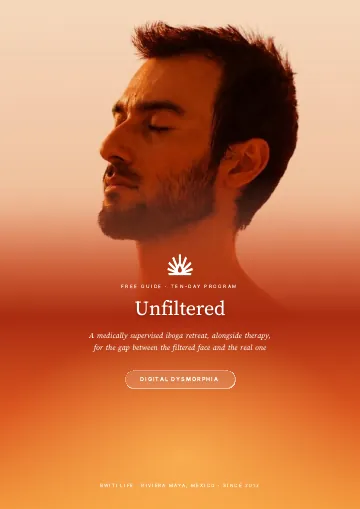
Free guide · PDF
Unfiltered
Digital dysmorphia: the ceremony, the numbers, the research and how to prepare.
How it works
Digital dysmorphia, sometimes called "Snapchat dysmorphia", is not a medical diagnosis, and no study has tested iboga or ibogaine for it or for body dysmorphic disorder. So we never promise a change in how you see yourself. What we offer is a supervised opening alongside therapy: days away from the camera, a long night of reflection held by a tradition and a medical team, then three months of support at home.
Before you travel, our physician reviews your health and your medicines. On the night she and the medical team are in the room. The practitioner gives the medicine in steps, watching each guest.
In the Missoko Bwiti tradition the ceremony begins with the person, not the appearance. Guests often describe a long, lucid review of their life, sometimes including where the harsh eye on their own face began, long before the first filter. Belief is not required.
Your phone, and its camera, stay in a drawer from the first ceremony to the last integration day. With your consent we write to your own therapist, so the work on editing, checking and comparing goes on at home through three months of integration calls.
How iboga acts on the brain
Editing, checking and comparing work like a loop: a flash of dislike, a fix or a check, brief relief, then the urge again. In theory, the iboga alkaloids touch systems tied to fixed loops like this. Ibogaine acts on NMDA glutamate receptors involved in learning. Ibogaine and its long-lived metabolite noribogaine both act on the serotonin transporter, the same target as the SSRIs used for body dysmorphia. Animal studies suggest a single dose switches on growth-factor genes linked to plasticity.
None of this has been tested for digital dysmorphia or body dysmorphic disorder. The best human data come from small open-label studies, such as one of 30 veterans published in Nature Medicine in 2024, which had no control group. Read it as theory, not proof. More on the science in how iboga works.
What we have seen since 2012
Since 2012 we have welcomed 7,677 guests. Some arrived with years of selfies edited until the unfiltered face felt like a stranger. In that time we have seen a traditional treatment help people with this kind of struggle, sometimes profoundly and lastingly.
Guests describe days without a camera as uncomfortable at first, then freeing. Some say that after the ceremony they could look at an unedited photo of themselves and see a person, not a list of flaws. This is our experience, not a clinical study.
Who holds it
Michael and Cory open and hold the ceremony; Tania, our psychologist with close to a decade at Mexico's National Institute of Psychiatry, screens for what iboga cannot hold and carries the integration; Dr Villarreal keeps the body safe.


Safety
Three things matter most: your safety today, your medicines, and an honest screening.
Your safety first. When appearance worry becomes body dysmorphic disorder, thoughts of ending one's life are common; in one study of 200 people with BDD, 78% had had them. There is no shame in that. Call or text 988 in the US or Canada, today. Acute suicidality is a reason to get care at home first: the retreat can wait, you matter more.
Medicines. Many people with body dysmorphia take an SSRI. Some SSRIs change how the body clears ibogaine, so never stop on your own: any taper is planned well ahead with your prescriber and our physician.
Screening. We screen for body dysmorphic disorder, depression, eating disorders, bipolar disorder and psychosis. Distress about appearance can surface intensely during the night, so we plan close support and integration. Every guest has a medical screening before travel; read how we protect your heart. Tell us every medicine you take, and never stop one on your own. Guests must be 18 or older.
Who it is for
The retreat suits people who want a long look at where the harsh eye began, and who are ready to keep working after.
Adults whose filtered or edited image has become the standard they hold their real face to, with or without a diagnosis of body dysmorphia. It fits best if you are in therapy or ready to start.
Active psychosis or recent mania, acute suicidality, an unstable eating disorder, a medication that cannot be tapered in time, pregnancy, or a serious medical condition. The psychologist and the physician decide together; sometimes the answer is a later date.
Why it is hard
The term "Snapchat dysmorphia" comes from a 2018 commentary in JAMA Facial Plastic Surgery, about people asking surgeons to look like their filtered selfies. It is not a diagnosis, and no study has measured how common it is. The related diagnosis is body dysmorphic disorder; if that sounds closer to you, read our page on iboga for body dysmorphia. In a 2019 member survey, 72% of US facial plastic surgeons in the AAFPRS saw patients seeking procedures to look better in selfies.
Filters set a standard no real face can meet, and editing brings brief relief, then a new flaw. In one survey of 252 people, users of Snapchat filters or Facetune were more open to cosmetic surgery. Studies like these are snapshots: they show links, not that filters cause body dysmorphia.
How to cope
No trial has targeted digital dysmorphia itself. If body dysmorphic disorder is present, CBT designed for BDD has the best evidence: in a review of seven randomized trials, it worked. An SSRI prescribed by a clinician helps many people too.
A note on cosmetic procedures. They are not a treatment. Among people with BDD, only about 2.3% improved overall in the long term after cosmetic treatment (IOCDF), and the worry often moves to another part of the body.
Cut back on editing and filters, one step at a time: post one photo unedited, or take a week off the beauty filter. Set a limit on selfie checking, notice the urge rise, then let it fall. Unfollow accounts that leave you feeling worse. These steps are low risk, though untested.
If appearance worry takes hours of your day, or brings hopelessness, find a therapist who knows BDD through bdd.iocdf.org or the BDD Foundation. If the feed itself is the trap, read our page on how to quit social media.
If you are thinking about ending your life, call or text 988 in the US, or 9-8-8 in Canada, today. In the US you can also chat at chat.988lifeline.org or text HOME to 741741. For free referrals to mental health care in the US, call the SAMHSA National Helpline at 1-800-662-HELP (4357); it is not a crisis line.
Dates
Open retreats and the dedicated veterans' dates. Eight guests each; full list on the schedule.
Your face does not need a filter to be welcome here. Come as you are; we will hold the night with you.
Pricing, US dollars
All inclusive from Cancún airport: screening, ceremonies, room, meals, three months of follow-up. All payments are final, see the terms. Full pricing.
Questions about digital dysmorphia
A term from a 2018 commentary for wanting to look like your filtered selfies, sometimes to the point of seeking surgery. It is not a diagnosis.
The concern is real, and surgeons report seeing it. It is not a recognized disorder, and no study has measured how common it is.
Surveys link filter and editing use with appearance worry and openness to surgery, but they cannot show cause. Causation is unproven.
Surgeons report it. In a 2019 member survey, 72% of US facial plastic surgeons in the AAFPRS saw patients seeking procedures to look better in selfies. That is a survey of surgeons, not of the public.
No. Body dysmorphic disorder is a diagnosis with set criteria. Filter worries can be part of BDD, or a milder concern on their own. Read our page on iboga for body dysmorphia.
Rarely, when BDD is present: only about 2.3% of people with BDD improved overall in the long term after cosmetic treatment, and the worry often moves elsewhere.
If appearance worry takes hours of your day, keeps you from going out, or brings hopelessness. If you have thoughts of ending your life, call or text 988 in the US or Canada now.
No study has tested iboga or ibogaine for digital dysmorphia or body dysmorphic disorder, so we do not claim it does. What we offer is a supervised night of reflection inside a tradition, with a psychologist before and after, as a complement to therapy.

You've carried this long enough. Start with a conversation with our medical team.
