Parkinson's disease
Whether you live with Parkinson's or you are reading this for a mother or a father, you are welcome here. Iboga's alkaloids act on the same dopamine system that Parkinson's wears down, and in animal research they raise GDNF, the brain's own growth factor for dopamine cells. It is early science, not a cure. What we offer is a traditional Missoko Bwiti ceremony, a physician on site day and night, and a medical team that reviews every file and plans the retreat around your Parkinson's.
Free guide · PDF
Steady Through the Night
Parkinson's: the ceremony, the numbers, the research and how to prepare.
How we can help
Parkinson's is more than a tremor. It touches movement, sleep, energy and mood, and it changes how a person sees the years ahead. A retreat with us works on all of it at once: the medicine and the ceremony for the mind and the spirit, a medical team for the body, and three months of follow-up so that what opens during the stay has time to settle into daily life.
Iboga's alkaloids reach the circuits Parkinson's affects. In animals they raise growth factors that protect dopamine cells. In people, this has not been proven yet.
About one person in three with Parkinson's lives with significant depressive symptoms. Low mood, anxiety and loss of drive are where iboga has its longest track record.
The ceremony's life review gives room for fear, grief and the question of how to live well from here. Many guests leave with a clearer sense of what matters.
We will not promise to slow, stop or reverse Parkinson's, and no one honestly can. Iboga does not replace levodopa, your neurologist or your therapy. In the tradition you come without expectations; what we can promise is careful preparation, a team at your side all night, and honesty about what is known.
The mechanism
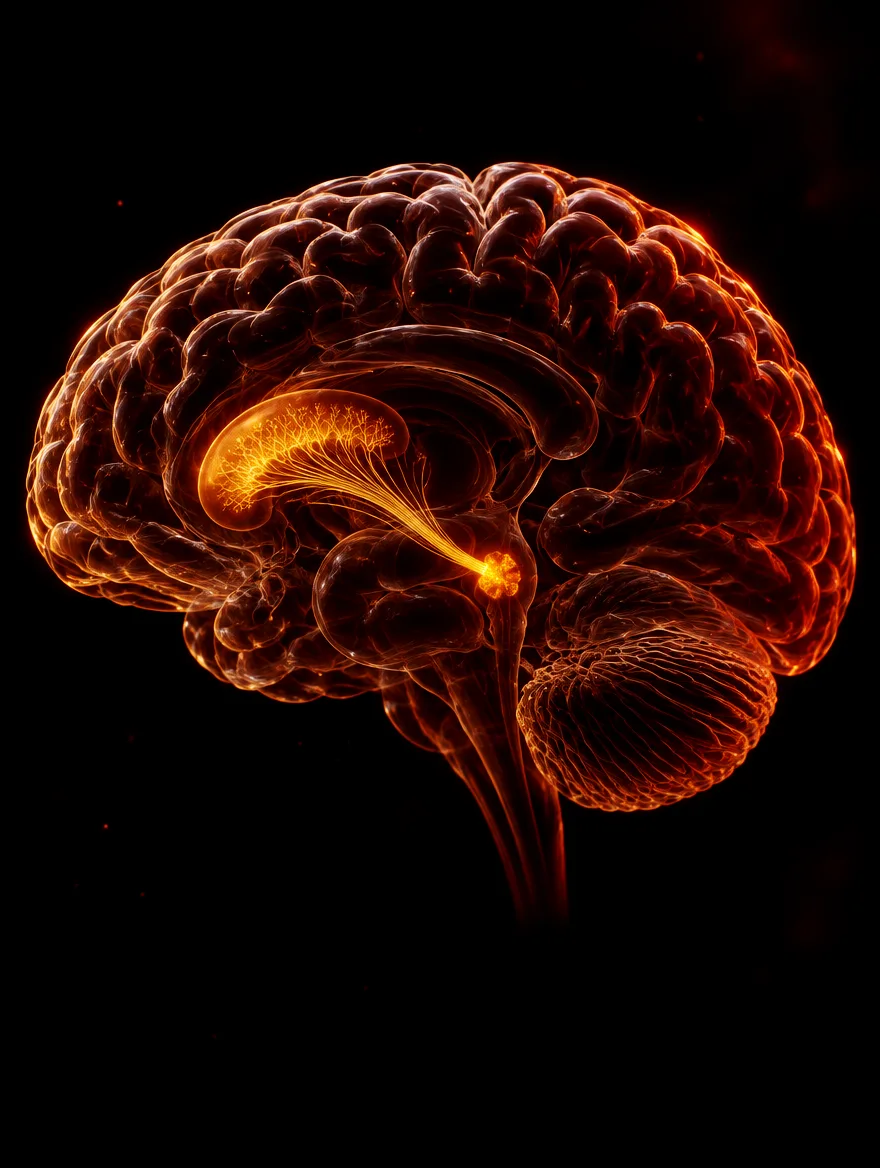
Movement depends on a pathway that runs from a small dark area deep in the brain, the substantia nigra, to the striatum, which plans and smooths movement. Its messenger is dopamine. In Parkinson's, the dopamine cells of the substantia nigra slowly die, and clumps of a protein called alpha-synuclein build up inside them. Symptoms usually appear when more than half of those cells are already gone.
Iboga's main alkaloid, ibogaine, is turned by the liver into noribogaine, which stays in the body for days. In rats, a single dose of ibogaine switched on the gene for GDNF, a growth factor that keeps dopamine cells alive, in the substantia nigra itself, and raised GDNF protein in the area next to it. This is animal research, not proof in people. The animation shows the idea, step by step.
The alkaloids in iboga root bark
The main alkaloid. Acts on dopamine, serotonin, opioid and NMDA receptors, and is the one studied for growth factors.
Made from ibogaine by the liver. Half-life of 28 to 49 hours in healthy volunteers, which is why the effects last beyond the night.
Present in the whole root bark, less studied. One reason a ceremony with the root is not the same as a pill of ibogaine.
The dopamine pathway, in motion
Step 4 · What animal studies suggestIn rats, iboga raised the brain's own protective growth factor, GDNF (the golden glow), next to the dopamine cells. GDNF helps the cells that remain survive and stay connected. Cells already lost do not come back. In people, one published case found steadier movement after ibogaine; a single case does not prove it works.
The science in plain words
None of what follows proves that iboga treats Parkinson's. It explains why the question is serious, and why we describe it as theory.
GDNF (glial cell line-derived neurotrophic factor) is one of the strongest known survival signals for dopamine cells. It protects and restores them in rodent and primate models of Parkinson's. In rats, 24 hours after a single high dose, ibogaine switched on the GDNF gene about six-fold in the substantia nigra and twelve-fold in the nearby ventral tegmental area; GDNF protein itself rose about two-fold, in the ventral tegmental area only.
GDNF itself cannot cross from the blood into the brain. In trials it had to be pumped directly into the brain through surgically placed tubes: dopamine scans improved, but a 2019 placebo-controlled trial missed its main goal. Ibogaine is a small molecule taken by mouth that, in animals, makes the brain produce more of its own GDNF. That is the theory, and it is untested in Parkinson's.
Ibogaine and noribogaine bind the dopamine transporter, the protein that recycles dopamine. In cells, and for noribogaine also in fruit flies, they help faulty versions of it fold properly and reach the cell surface. This was studied for a rare inherited childhood parkinsonism, not for common Parkinson's, but it shows how directly these alkaloids act on the dopamine machinery.
A 52-year-old woman with Parkinson's took small daily doses of purified ibogaine for 80 days. Her scores improved for movement, quality of life, fatigue and depression; her sleep got worse. It is one person, without a control, and a very different regimen from a ceremony. The authors themselves call for controlled trials.
Most of the dopamine cells are lost in the first years after diagnosis. If protection is possible, it matters most early, which is why we strongly recommend coming at an early stage.
Read it honestly
There is no controlled clinical trial of iboga or ibogaine in Parkinson's. The growth-factor findings are from rats; the human evidence is a single case.
The research used purified ibogaine. A Bwiti ceremony uses the whole root bark, in doses set and paced by the practitioner, under our physician's limits.
We cannot tell you whether your tremor, stiffness or walking will change, for how long, or at all. Some guests feel more energy and lighter mood; others notice little in the body.
If you read elsewhere that a clinic "reverses" Parkinson's, ask for the published data. We would rather tell you less and be right. See iboga vs ibogaine and how iboga works.
Who can come
Parkinson's changes the medical picture: the heart, blood pressure, balance and several Parkinson's medicines all matter for iboga. Our physician reviews every application before anything is confirmed, and decides with you whether and how a retreat can be planned. Sometimes the answer is no, or not yet, and we will say so plainly.
Never stop or change a Parkinson's medicine on your own. Stopping levodopa suddenly can cause a rare but dangerous reaction. Our physician plans every change with you and your neurologist, sometimes weeks in advance.
When you were diagnosed, your stage if your neurologist has given one, and how your symptoms change through the day.
Levodopa, dopamine agonists, MAO-B inhibitors such as rasagiline or selegiline, amantadine, anti-nausea medicines and supplements. Some act on serotonin or heart rhythm, as iboga does.
A blood panel, and a recent ECG with its medical report, no later than one week before your start date. Ibogaine affects heart rhythm: how we protect your heart.
Dizziness or fainting when you get up. Parkinson's and iboga can both lower blood pressure, so the team plans how you rest and move.
Iboga makes walking unsteady for a day or two. You stay lying down during the ceremony, with someone beside you whenever you need to stand.
Any trouble swallowing, acting out dreams at night, confusion or hallucinations, so our physician can judge the risks with you.
Your neurologist's latest letter, any DaTscan or MRI report, and your medication schedule.
Someone to travel with you to Cancún and home again. Tell us early, so we can plan for them.
Talk with them about your plans, and share their contact details so our physician can reach them.
These requests help us prepare; they are not medical promises. The physician's review decides how the retreat is planned for you. More on preparation and the medical protocol.
For sons and daughters
Many of the people who first contact us about Parkinson's are the children of the person who lives with it. You are welcome on every step: on the discovery call, in gathering the records, and on the trip itself as their companion. The decision stays your parent's, and the medical review is the same for everyone.
Ask every question, with your parent beside you. Book a discovery call.
The neurologist's letter, the medication list and a recent ECG.
Our physician reads the file and tells you plainly whether a retreat is safe to plan.
Who holds it
Practitioners initiated in Gabon hold the ceremony. Our physician and psychologist hold the body and the mind, and Lisa is your one contact from first call to flight home. Meet everyone on the team page.


Your stay
Medical review of your file, your neurologist's letter, an ECG and bloodwork, a plan for your medicines, and a call with the psychologist.
The root is given in steps, the practitioner watching you before giving more, the physician in the room all night. See the ceremony.
Rest, gentle movement at your own pace, talking through the night's life review, time in nature at the cenote.
Four integration calls over three months, specialist follow-up at one and three months, and a summary for your neurologist if you want one. Exercise, sleep and your usual care carry on: they remain the best-proven way to live well with Parkinson's.
Dates
Ten or fourteen days on the neurological program, from the same arrival date, eight guests each; full list on the schedule. Apply early: the medical review of a Parkinson's file can take a little longer.
The neurological program
Parkinson's, Alzheimer's and multiple sclerosis each need more than a standard retreat. On the neurological program, specialists in your condition join our physician before you travel, while you are with us and after you go home, and they work with your own neurologist. Ten or fourteen days, in a private room, so there is time to settle, adjust and be observed.
Neurological program · US dollars, per person
Everything in our standard program, plus the specialists and care listed here. The $500 deposit is refunded in full if our medical team cannot clear you.
With every neurological guest: our physician around the clock, a cardiologist for the ECG before and the heart monitoring during ceremonies, and our psychologist, Tania González.
Questions about Parkinson's
No one can promise that, and we will not. In rats, ibogaine raised GDNF, a growth factor that protects dopamine cells, and one published case described improvements with small daily doses. There is no controlled trial in Parkinson's. It is a serious hypothesis, not a proven treatment.
For two reasons. Safety: balance, blood pressure, swallowing and medicines are usually simpler early on. And the science: most dopamine cells are lost in the first years after diagnosis, so if growth factors can protect anything, there is more to protect early. Every file is still reviewed individually by our medical team.
Never on your own. Declare every medicine on your health form. Our physician decides with you and your neurologist what continues, what is adjusted and when. MAO-B inhibitors and some anti-nausea medicines need particular planning.
Age alone does not decide it; the heart, the medicines and the overall health do. Ibogaine affects heart rhythm, so every guest has an ECG and bloodwork before travel and cardiac monitoring during the ceremony. Our physician may decline, or ask for more tests, and will explain why.
You stay lying down during the ceremony, and someone helps you every time you need to stand. Your room is chosen and prepared for safe movement, and the team stays with you through the night and the next day, while walking is unsteady.
Yes, and with Parkinson's we strongly advise a companion for the journey. Tell us early so we can plan their trip to Cancún and home again with you.
Then your deposit is refunded in full, and we tell you why. Sometimes the answer is a later date, after a medicine change or more tests.
Sources

You've carried this long enough. Start with a conversation with our medical team.