Alzheimer's disease
Whether you are in the early stage of Alzheimer's or reading this for a parent, you are welcome here. The plain truth first: no study has ever tested iboga in Alzheimer's, in people or in animals, and no one can promise it will slow the disease. What we offer is a traditional ceremony, a physician on site day and night, and a medical team that plans the retreat around your health.
Free guide · PDF
While You Can Choose
Alzheimer's: the ceremony, the numbers, the research and how to prepare.
How we can help
A diagnosis of Alzheimer's or mild cognitive impairment changes how a person sees the years ahead, and it changes the whole family. People who come to us at this stage rarely come for a cure. They come for the ceremony itself: to look back over a life, to face the fear, and to decide how to live the time ahead. A retreat with us holds all of it: the medicine and the ceremony for the mind and the spirit, a medical team for the body, and three months of follow-up.
Your heart, your memory medicines, your sleep and your balance are reviewed before anything is confirmed, and watched through every night.
Room to speak about what frightens you, with a practitioner beside you during the night and a psychologist before and after.
The ceremony's life review looks back over the whole of a life. Many guests leave with a clearer sense of what matters, and what they want to say to the people they love.
We will not promise to slow, stop or reverse Alzheimer's, and no one honestly can. Iboga does not replace your memory medicines, your neurologist or your memory clinic. In the tradition you come without expectations; what we can promise is careful preparation, a team at your side all night, and honesty about what is known.
The mechanism
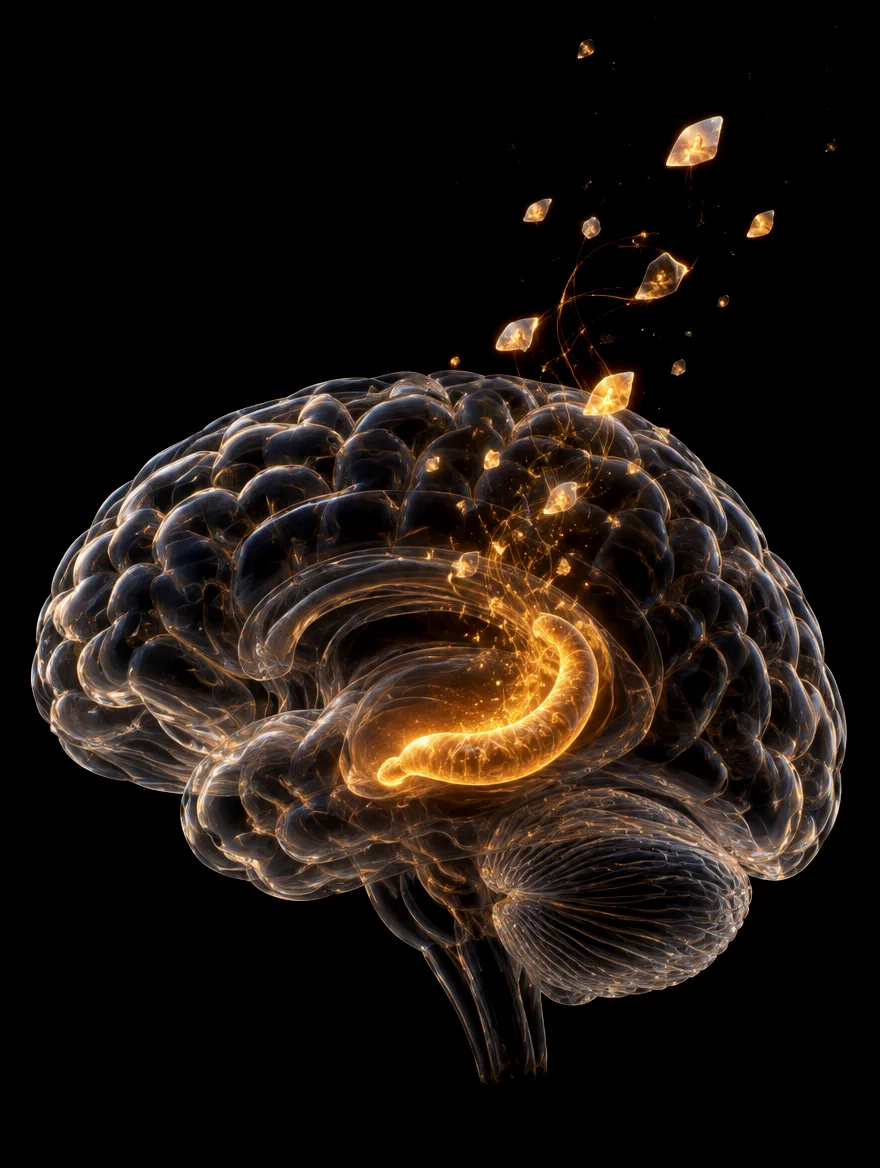
New memories are made in the hippocampus, a small curved area deep inside each side of the brain. Its nerve cells talk to each other across tiny connections called synapses. In Alzheimer's, a protein called amyloid gathers between the cells as plaques, a protein called tau twists into tangles inside them, connections are lost, and recent memories begin to slip.
Iboga's main alkaloid, ibogaine, is turned by the liver into noribogaine, which stays in the body for days. In rats, ibogaine raised some of the brain's own growth factors, in brain areas other than the memory centre. No one has tested any of this in Alzheimer's, in animals or in people. The animation shows the disease and the arrival of the alkaloids; its last step shows only what the growth-factor studies in rats suggest, and no change for the person.
The alkaloids in iboga root bark
The main alkaloid. Acts on dopamine, serotonin, opioid, NMDA and sigma-2 receptors, and is the one studied for growth factors.
Made from ibogaine by the liver. Half-life of 28 to 49 hours in healthy volunteers, which is why the effects last beyond the night.
Present in the whole root bark, less studied. One reason a ceremony with the root is not the same as a pill of ibogaine.
The memory centre, in motion
Step 4 · Growth factors, in animalsIn rats, one dose of ibogaine raised the brain's instructions for growth factors such as BDNF and GDNF (the faint golden glow), but the BDNF protein itself did not rise significantly, and GDNF protein rose in one area only. None of these studies looked at the memory centre or used an Alzheimer's model. Nothing has been measured in Alzheimer's, so the picture shows no change in what the person notices.
The science in plain words
None of what follows shows that iboga helps in Alzheimer's. These are the threads that lead people to ask the question, and some of them may point the other way. We describe all of it as theory.
BDNF (brain-derived neurotrophic factor) helps nerve cells survive and keep working. In brain tissue studied after death, mature BDNF in the parietal cortex was 34% lower in people who had mild cognitive impairment and 62% lower in people with Alzheimer's, compared with people without memory problems. Lower levels went with lower scores on thinking tests.
A day after one dose, rats had more of the brain's instructions (messenger RNA) for BDNF in several areas, but the BDNF protein itself did not rise significantly. GDNF protein rose in one dopamine area only; an earlier study linked that GDNF rise to rats drinking less alcohol. None of these studies looked at the hippocampus or used an Alzheimer's model.
Ibogaine binds the sigma-2 receptor, and in cells it raised calcium the way sigma-2 activators do. Zervimesine (CT1812), an investigational Alzheimer's drug in clinical trials, blocks that receptor, to keep toxic amyloid clumps from binding to nerve cells. So iboga touches the same receptor, but probably pushes it the other way. This is theory only, and it may count against iboga rather than for it.
In nerve cells grown in the lab, ibogaine blocked NMDA receptors, part of the brain's glutamate signalling, and protected the cells from damage by too much glutamate. Memantine, an approved Alzheimer's medicine, also blocks NMDA receptors. A shared target is not a shared effect: memantine is taken every day at steady levels, and nobody has compared the two.
We strongly recommend an early stage for one reason above all: the person who comes should be able to understand the ceremony, choose it, and say yes or no for themselves.
Read it honestly
No published study has tested ibogaine, noribogaine or iboga in Alzheimer's or mild cognitive impairment, in people or in animal models, and no trial is registered on ClinicalTrials.gov (checked November 2026).
At Stanford, 30 male veterans with mostly mild brain injuries received magnesium with ibogaine, in an open study with no control group. Their daily functioning improved, as did their reported thinking, with no serious adverse events. They were younger people, with a different condition.
The research used purified ibogaine. A Bwiti ceremony uses the whole root bark, in doses set and paced by the practitioner, under our physician's limits.
We cannot tell you whether memory, orientation or daily life will change, for how long, or at all. We will not tell you that the disease will slow.
If you read elsewhere that a clinic "reverses" Alzheimer's or dementia with iboga, ask for the published data: we could not find any. We would rather tell you less and be right. See iboga vs ibogaine and how iboga works.
Who can come
Alzheimer's changes the medical picture: memory medicines, the heart, night-time confusion, balance and the ability to decide all matter for iboga. Our physician reviews every application before anything is confirmed, and decides with you whether and how a retreat can be planned. Sometimes the answer is no, or not yet, and we will say so plainly.
Never stop or change a prescribed medicine on your own. Our physician plans every change with you and your doctors, sometimes weeks in advance.
You must understand what a ceremony is and choose it yourself. Our physician speaks with you directly, not only with your family. If you can no longer make this decision, we will say no.
Someone who knows you well, to travel with you to Cancún, stay with you and fly home with you. Tell us early, so we can plan for them.
When you were diagnosed, whether it is mild cognitive impairment or Alzheimer's, your latest memory test scores, and which tests confirmed it.
Donepezil, rivastigmine and galantamine slow the heart rate. Ibogaine also affects heart rhythm, so these medicines need a cardiac review before anything is planned.
Some medicines lengthen the QT interval of the heartbeat, for example citalopram and some antipsychotics, sometimes given for mood, sleep or agitation. Iboga does too. Declare every one, with supplements.
If you receive lecanemab or donanemab, the timing of infusions, recent MRI findings of brain swelling or small bleeds (ARIA), and any blood thinners are questions for your neurologist before we plan anything.
A blood panel, and a recent ECG with its medical report, no later than one week before your start date. Ibogaine affects heart rhythm: how we protect your heart.
People with memory loss are more prone to sudden confusion (delirium), especially at night and in a new place. Someone stays with you through the night, your companion stays close, and the team watches for it on the days after.
Iboga makes walking unsteady for a day or two. You stay lying down during the ceremony, with someone beside you whenever you need to stand. Tell us about any falls or trouble swallowing.
Your neurologist's or memory clinic's latest letter, any MRI or PET report, and your medication schedule.
Talk with them about your plans, and share their contact details so our physician can reach them.
These requests help us prepare; they are not medical promises. The physician's review decides how the retreat is planned for you. More on preparation and the medical protocol.
For sons and daughters
Many of the people who first contact us about Alzheimer's are the children of the person who lives with it. You are welcome on every step: on the discovery call, in gathering the records, and on the trip itself as their companion. The decision must be your parent's own, made while they can understand it, and the medical review is the same for everyone.
Share this page with them. A retreat only makes sense if they want it for themselves.
Ask every question, with your parent beside you. Book a discovery call.
The neurologist's letter, the medication list and a recent ECG.
Our physician reads the file, speaks with your parent, and tells you plainly whether a retreat is safe to plan.
Who holds it
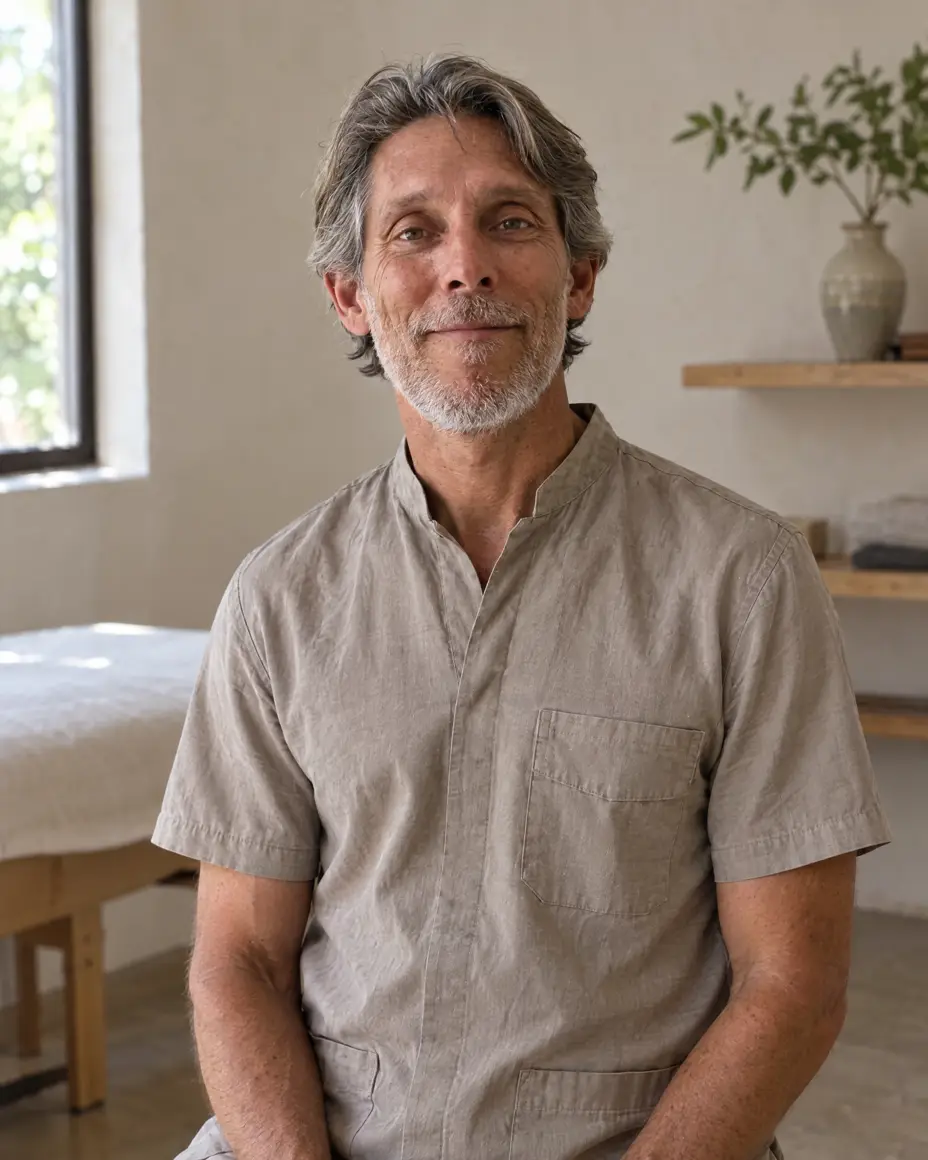
Practitioners initiated in Gabon hold the ceremony. Our physician and psychologist hold the body and the mind, and Lisa is your one contact from first call to flight home. Meet everyone on the team page.


Your stay
Medical review of your file, your neurologist's letter, an ECG and bloodwork, a plan for your medicines, a conversation with you about consent, and a call with the psychologist.
The root is given in steps, the practitioner watching you before giving more, the physician in the room all night, your companion close by. See the ceremony.
Rest, a calm routine, gentle movement at your own pace, talking through the night's life review, time in nature at the cenote.
Four integration calls over three months, with your companion if you wish, specialist follow-up at one and three months, and a summary for your neurologist if you want one. Your usual care, your medicines and your memory clinic carry on.
Dates
Ten or fourteen days on the neurological program, from the same arrival date, eight guests each; full list on the schedule. Apply early: the medical review of an Alzheimer's file can take a little longer.
The neurological program
Parkinson's, Alzheimer's and multiple sclerosis each need more than a standard retreat. On the neurological program, specialists in your condition join our physician before you travel, while you are with us and after you go home, and they work with your own neurologist. Ten or fourteen days, in a private room, so there is time to settle, adjust and be observed.
Neurological program · US dollars, per person
Everything in our standard program, plus the specialists and care listed here. The $500 deposit is refunded in full if our medical team cannot clear you.
With every neurological guest: our physician around the clock, a cardiologist for the ECG before and the heart monitoring during ceremonies, and our psychologist, Tania González.
Questions about Alzheimer's
No one can promise that, and we will not. Iboga, ibogaine and noribogaine have never been tested in Alzheimer's or mild cognitive impairment, in people or in animal models. It is not a treatment for Alzheimer's.
For the ceremony itself: a life review, room for the fear and grief of the diagnosis, and time to decide how to live the years ahead. Some people want to do this while they can still fully choose it. Come for that, not for a change in memory.
Because the person must understand the ceremony and choose it for themselves, and because night-time confusion, falls, swallowing and medicines are usually simpler early on. Every file is still reviewed individually by our medical team, and a companion is required.
Never on your own. Declare every medicine on your health form. Our physician decides with you and your neurologist what continues, what is adjusted and when. Memory medicines that slow the heart, medicines that affect heart rhythm and anti-amyloid infusions need particular planning.
Age alone does not decide it; the heart, the medicines, the risk of confusion and the overall health do. Ibogaine affects heart rhythm, so every guest has an ECG and bloodwork before travel and cardiac monitoring during the ceremony. Our physician may decline, or ask for more tests, and will explain why.
Yes, and with Alzheimer's or mild cognitive impairment a companion is required. Tell us early so we can plan their trip to Cancún and home again with you.
Then your deposit is refunded in full, and we tell you why. Sometimes the answer is a later date, after a medicine change or more tests.
Sources

You've carried this long enough. Start with a conversation with our medical team.