The research, study by study

What the science on iboga actually shows, and what it does not.

We read every human study we could find on iboga and ibogaine, from addiction to brain injury to the heart. A second reader then opened each paper again to check every number. This page shows the results with the researchers' own figures where their licence allows, our own charts where it does not, and a plain word on how strong each piece of evidence is. Some of it is encouraging. None of it is proof yet.

  • 35human studies read and checked, from 1999 to 2026
  • 0randomised, placebo-controlled trials showing that iboga or ibogaine treats any condition
  • Mostbehavioural conditions we write about have no human study yet
Scroll to explore

How to read it

Not all studies weigh the same

Medicine ranks evidence like the rungs of a ladder. The higher the rung, the more confident we can be that a treatment, and not hope, chance or time, caused the change. Most iboga research sits on the middle rungs.

  1. Randomised, placebo-controlled trials of benefitNone yet, for any condition.
  2. Randomised safety trialsOne, of noribogaine in 27 people on methadone. It measured safety and heart rhythm, not recovery.
  3. Prospective studies without a control groupWhere the best evidence sits: veterans with brain injury, opioid detox, a hospital pilot in alcohol use.
  4. Surveys and chart reviewsSeveral, mostly of veterans and people treated for opioid use. People recall how they felt before.
  5. Case reportsOne person, or a handful: MS, Parkinson's, ketamine, nerve pain, brain injury, and cardiac emergencies.
  6. Animal and cell researchThe only evidence for Alzheimer's and most behavioural conditions.
The evidence ladder. Filled rungs are where human iboga and ibogaine research exists today; the top rung is still empty.

Two more things to keep in mind on every result below. Almost all of these studies used ibogaine, the purified alkaloid, in a clinic; a Bwiti ceremony uses the whole root bark, and the two have never been compared directly (iboga vs ibogaine). And most of the human studies so far were run without a comparison group, many of them in commercial clinic settings, by teams who believe in the treatment. That does not make them wrong. It is why we call them early.

The evidence map

Condition by condition, how much is known

Every condition we write about, with the human research that exists for it today.

ConditionEvidenceWhat exists in peopleRead more
Opioid withdrawal and opioid useMost studied8 studies, about 360 people, 1999 to 2024: withdrawal scores, relapse at up to 12 months, one safety trial with placeboOpioids · below
PTSD, brain injury, veteransMost studied3 groups of veterans, about 170 people, followed up to 12 months; brain scans, EEGPTSD · TBI · Veterans
Depression and anxietyEarlyMeasured as a second outcome in the veteran and opioid studies; no study of its ownDepression and anxiety
AlcoholEarlyA hospital pilot of 9 people, and 45 veterans who drank heavilyAlcohol · below
Cocaine and crackEarly89 people in one detox series, and a few in the alcohol pilotCocaine
KetamineSingle caseOne man, followed for 17 monthsKetamine · below
Multiple sclerosisSingle casesOne report of two people, with MRIMS
Nerve painSingle caseOne man with long-standing pain after the nerves of his arm were torn at the spinebelow
Parkinson'sSingle caseOne woman, 80 days of low-dose ibogaine; the idea comes from growth-factor research in ratsParkinson's
Alzheimer's and dementiaAnimal onlyNo human studyAlzheimer's
Heart safetyMost studiedHeart-rhythm studies, death reviews, and outcomes from 19,071 treated peopleThe heart · below

No human study yet, for any of these: methamphetamine and Adderall, cannabis, benzodiazepines, kratom, smoking, chemsex drugs, gambling, food, porn, gaming, social media, shopping, OCD, personality conditions, grief, anger and loneliness. For these, everything we write is about the ceremony and what people tell us, not about research. More on the gaps.

PTSD, brain injury and veterans

Thirty veterans, four scores, and a year of follow-up

In 2024, a Stanford team published the most cited human study of ibogaine to date, in Nature Medicine. Thirty male Special Operations veterans with repeated brain injuries took ibogaine together with magnesium, to protect the heart, and were assessed before, just after, and one month later. The same men were then followed for a year.
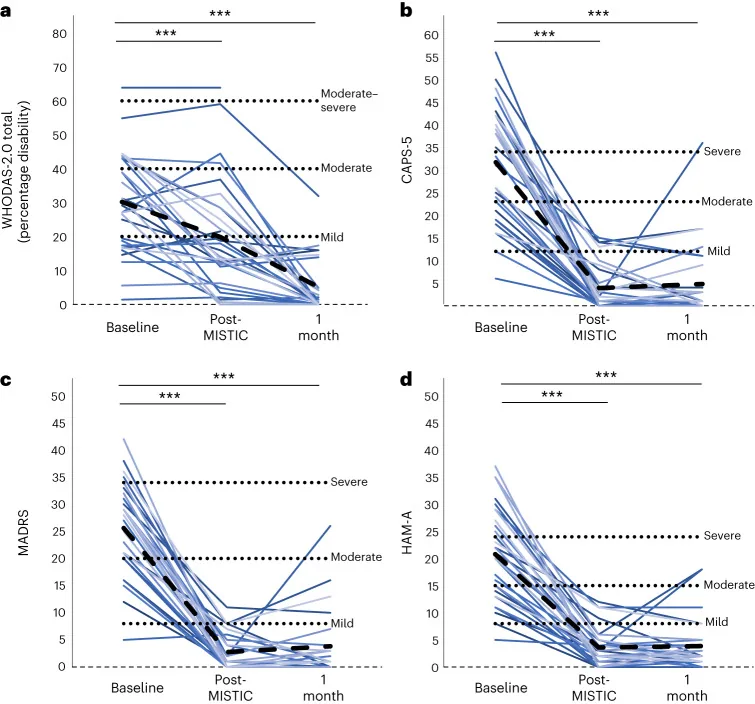
Four line charts from the Nature Medicine study. Each thin line is one veteran, the thick dashed line is the average. Disability, PTSD, depression and anxiety scores all fall steeply from baseline to just after treatment and stay low at one month, with a few individual lines rising again.
Every veteran, every score. Each thin line is one man; the dashed line is the group average. Panels: disability (a), PTSD (b), depression (c) and anxiety (d). Dotted lines mark severe, moderate and mild. A few lines climb again at one month. Cherian et al., Nature Medicine 2024, Figure 2.

Average scores, before treatment, at one month and at twelve months
PTSD CAPS-5
31.74.84.4
Depression MADRS
25.63.84.9
Anxiety HAM-A
20.83.93.7
Disability WHODAS
30.25.18.4
  • Before
  • 1 month
  • 12 months
Lower is better. Our chart, from the means reported by Cherian et al. 2024 and Faerman et al. 2026 (25 men at twelve months). Of those whose PTSD went into remission after treatment, an estimated 84% were still in remission a year later; for depression 66%, for anxiety 61%.
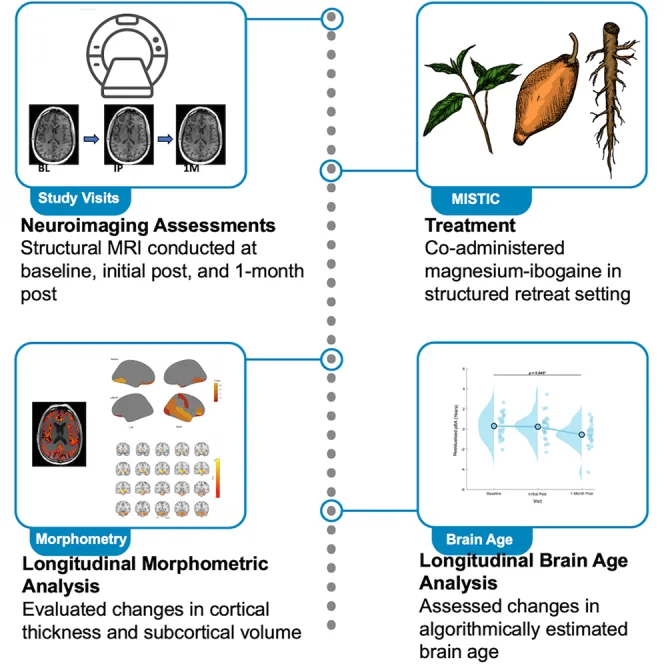
The graphical abstract of the brain-scan study: MRI at baseline, just after and one month after magnesium-ibogaine, analysed for cortical thickness, deep-brain volume and predicted brain age.
What the brain scans looked at. In 25 of the men, the cortex was thicker in 11 regions just after treatment, and the brain's predicted age was slightly younger at one month (39.4 to 38.5 years). These changes did not track the fall in disability scores. Geoly et al., iScience 2026, graphical abstract.
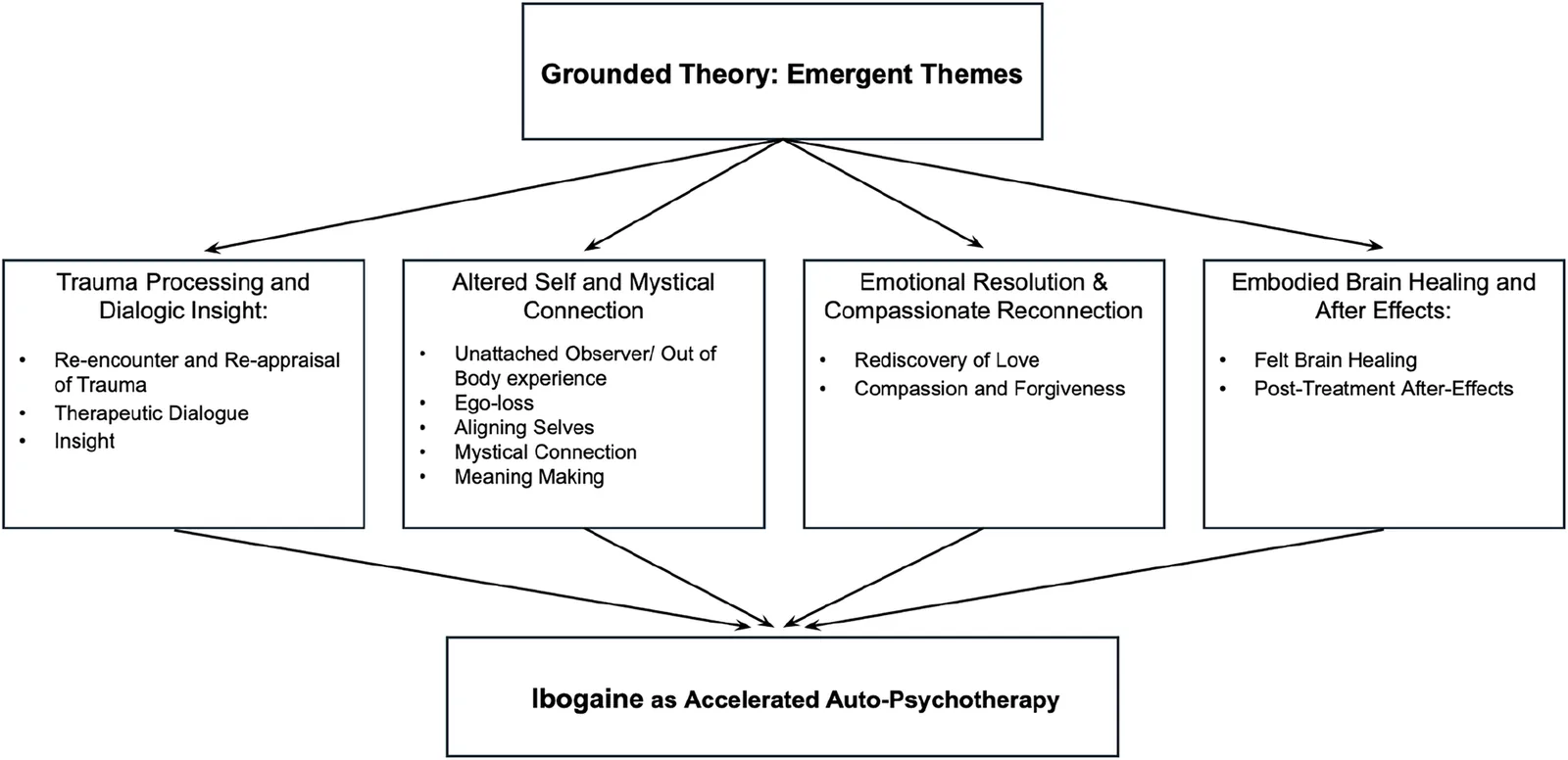
A diagram of four themes from the veterans' written accounts: trauma processing and dialogue, altered self and mystical connection, emotional resolution and reconnection, and felt brain healing, leading to ibogaine as accelerated self-directed psychotherapy.
What the veterans said happened. In their own written accounts, the men described re-living and re-appraising old memories, a changed sense of self, forgiveness and love, and a felt sense of the brain healing. It reads much like the life review at the heart of a Bwiti ceremony. Olash et al., npj Mental Health Research 2026, Figure 1.

How to read this

  • No comparison group. Everyone was treated, and everyone knew it. Hope, the setting and the attention of a retreat can all move these scores.
  • The same 30 men. Seven papers, on symptoms, scans, EEG and experience, describe this one group. They are not seven separate confirmations.
  • Other psychedelics afterwards. By twelve months, 23 of 25 had used another psychedelic, most often 5-MeO-DMT, which muddies the long-term result.
  • Men only. There are no women in these veteran groups.
  • Two more groups agree. A survey of 51 veterans and a program review of 86 found similar falls in PTSD, depression and anxiety, though both also used 5-MeO-DMT.

Opioids

Withdrawal eases fast. Staying off opioids is harder.

Ibogaine has been studied for opioid withdrawal since the 1990s. The studies agree on the first days: withdrawal scores drop sharply, and most people do not go back to opioids during the stay. The months after are more mixed, and that is the honest centre of this evidence.

Withdrawal score, before and 1 to 3 days after ibogaine

Mexico, 30 people · before
31.0
after
14.0
New Zealand, 14 people · before
25.2
after
14.2
Subjective Opiate Withdrawal Scale, lower is better. Our chart, from Brown & Alper 2018 and Noller et al. 2018. A Dutch hospital study of 14 people found almost no objective withdrawal (median score 0), and 11 of 14 had not gone back to morphine 24 hours later.

What happened in the months after

  • 50%no opioid use in the past 30 days, at 1 month (Mexico, 30 people)
  • 33%the same, at 3 months, counting people who could not be reached as using
  • 30%never used opioids again, in a survey of 88 past patients; 70% relapsed, though many used less than before
  • 22 → 4average depression score, before and at 12 months (New Zealand, 11 people)
From Brown & Alper 2018, Davis et al. 2017 and Noller et al. 2018. One person in the New Zealand study died during treatment, at a provider later found in breach of its duty of care.
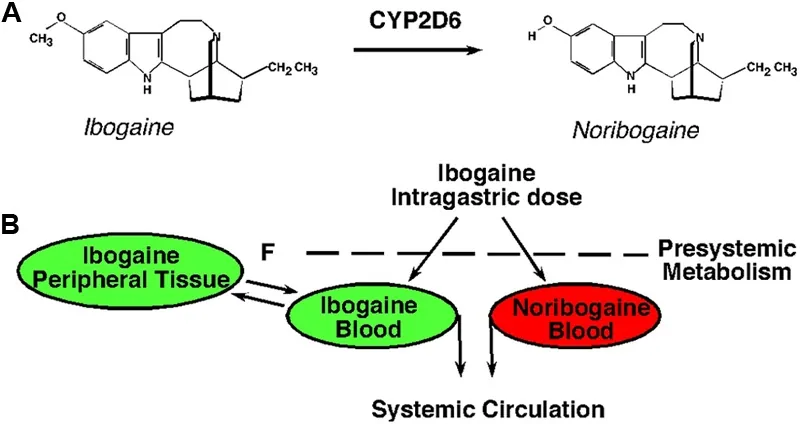
A diagram showing ibogaine turned into noribogaine by the liver enzyme CYP2D6, and how both reach the bloodstream.
Why two people react so differently. The liver enzyme CYP2D6 turns ibogaine into noribogaine, which stays in the body for a day or more. People's genes make this enzyme fast or slow, and some antidepressants block it, so the same dose can mean very different levels. Mash et al., Frontiers in Pharmacology 2018, Figure 1, from a detox series of 191 people with no serious adverse events.

How to read this

  • Small groups, no comparison. The largest follow-up study had 30 people; many dropped out, and use was mostly self-reported.
  • A single night is not a cure. Even in the best results, many people used opioids again within months. Aftercare matters as much as the ceremony.
  • No data on fentanyl. Every cohort used heroin, oxycodone, methadone or morphine. Fentanyl changes the risks, and has not been studied.
  • Not root bark. Every opioid study used purified ibogaine or noribogaine.

Alcohol, cocaine and ketamine

Small numbers, worth knowing

Beyond opioids, the human research is thin. Here is all of it that we could verify.

Drinks a month, before and 3 months after: six people in a hospital pilot

  • Person 548 → 0
  • Person 439 → 12
  • Person 938 → 21
  • Person 736 → 22
  • Person 335 → 5
  • Person 820 → 0
  • Before
  • 3 months
Standard drinks, self-reported. Our chart, from Rocha et al. 2026, a Brazilian university-hospital pilot using low doses of 400 mg or less. Three of nine people stopped early. The authors note that motivation and placebo could explain part of the change.

45 veterans who drank heavily: how they drank after

1 month

24%33%42%

6 months

16%31%53%
  • Not drinking
  • Lower-risk drinking
  • Still risky
Our chart, from Armstrong et al. 2024. Every one of them drank at a risky level before. Treatment combined ibogaine with 5-MeO-DMT, so the effect of ibogaine alone is unknown. More than half were drinking riskily again by six months.
A timeline from the ketamine case report, from intake and a first discharge in late 2024, through detox, ibogaine and integration in November 2024, to readmission, psychotherapy and continued abstinence into April 2026.
One man, 17 months. A 30-year-old using 2 to 3 grams of ketamine a day, with cocaine and alcohol, went through a supervised detox, ibogaine and integration. He reported his cravings gone within days, and his depression score fell from 32 to 14. With a second, smaller course 11 months later and ongoing therapy, his urine tests were negative and he was in sustained remission in April 2026. One case cannot show that ibogaine works; it shows what a careful course, with therapy before and after, can look like. Pérez Rosal et al., Frontiers in Psychiatry 2026, Figure 2.

Cocaine: in a detox series of 89 people dependent on cocaine, depression scores fell from 14.3 to 4.5 a month later, and there were no serious adverse events (Mash et al. 2018). There is no study of cocaine use after the first month.

The brain and nerves

Single cases, and a lot of theory

For neurological conditions, the human evidence is a handful of case reports. The rest is animal research on growth factors such as GDNF and BDNF, which no study has yet measured in people after ibogaine.

Safety and the heart

The best-measured risk is the heart

If the benefits of ibogaine are still early science, its main danger is well documented. Ibogaine slows the heart's recovery between beats, which shows on an ECG as a longer QT interval. In rare cases this triggers a chaotic rhythm that can stop the heart. Every safety step in our protocol comes from this research.

14 people in a Dutch hospital study, one ibogaine dose each

Our chart, from Knuijver et al. 2022. Half the group passed 500 ms, the level doctors treat as a warning. With continuous monitoring and magnesium, all recovered, and none developed a dangerous rhythm. All had a few hours of severe unsteadiness, gone within two days.

Deaths within 72 hours, 19,071 people treated in 11 clinics

  • 0.3deaths per 1,000 people treated: 6 in all
  • 6 of 10,382people treated for opioid use
  • 0 of 8,689people treated for anything else, such as PTSD or depression
From Arns et al. 2026, a preprint not yet peer reviewed. All six who died were men aged 45 to 49, treated for opioid use, half of them for fentanyl, at doses of 14 to 15 mg per kg. Across 48 deaths reported worldwide since 1990, 27 happened in clinics, 9 at home, 7 in underground settings and 3 in ceremonies.
An ECG strip showing a chaotic, twisting heart rhythm, a defibrillator shock, and a return to normal beats.
What we monitor for, and why. The twisting rhythm on the left is torsades de pointes; a shock (blue arrow) restores a normal beat (green arrow). It came from a 47-year-old man in Portugal, after a test dose given at a detox centre. He had four cardiac arrests, was resuscitated each time, and recovered fully. Mestre et al., Cureus 2024, Figure 1.

What this research changed in our protocol

  • The QT interval lengthens in most peopleA 12-lead ECG before you are accepted, reviewed by our physician; a long QT is a no.
  • The risk peaks in the hours after a doseCardiac telemetry all night, watched by the physician in the room.
  • Magnesium and fluids were used to protect the heartMagnesium and electrolytes by protocol, through an IV line placed before the ceremony.
  • Genes and some medicines change ibogaine levelsA full medicine review, and the root bark given in steps, watched before more is given.
  • Most deaths involved heart disease or other drugsHeart conditions, recent drug use and risky medicines are screened before anything is planned.

See the full medical protocol, iboga and the heart and can iboga kill you?

What we still do not know

The gaps, said plainly

We will update this page as new studies are published. If you know of a human study we missed, write to us and we will read it.

Sources

Every study on this page

Figures marked as reproduced are used under the Creative Commons Attribution licence (CC BY 4.0), resized, with our own captions. The other charts are ours, drawn from the numbers in each paper.

  1. Cherian KN, Keynan JN, Anker L, et al. Magnesium–ibogaine therapy in veterans with traumatic brain injuries. Nature Medicine 2024;30(2):373–381. Figure 2 reproduced, CC BY 4.0. Read ↗
  2. Faerman A, Lissemore JI, Geoly AD, et al. Is ibogaine treatment durable? 12-month follow-up of magnesium–ibogaine in veterans. Translational Psychiatry 2026. Read ↗
  3. Geoly AD, Coetzee JP, Buchanan DM, et al. Increased cortical thickness and decreased brain age among special operations veterans after magnesium–ibogaine. iScience 2026;29(3):115121. Graphical abstract reproduced, CC BY 4.0. Read ↗
  4. Olash C, Buchanan DM, Brown R, et al. Accelerated recovery using magnesium ibogaine: characterizing the subjective experience. npj Mental Health Research 2026;5:8. Figure 1 reproduced, CC BY 4.0. Read ↗
  5. Davis AK, Averill LA, Sepeda ND, et al. Psychedelic treatment for trauma-related psychological and cognitive impairment among US Special Operations Forces veterans. Chronic Stress 2020;4. Read ↗
  6. Davis AK, Xin Y, Sepeda N, Averill LA. Open-label study of consecutive ibogaine and 5-MeO-DMT assisted-therapy for trauma-exposed male Special Operations Forces veterans. Am J Drug Alcohol Abuse 2023. Read ↗
  7. Armstrong SB, Xin Y, Sepeda ND, et al. Prospective associations of psychedelic treatment for co-occurring alcohol misuse and PTSD among US Special Operations Forces veterans. Military Psychology 2024;36(2):184–191. Read ↗
  8. Brown TK, Alper K. Treatment of opioid use disorder with ibogaine: detoxification and drug use outcomes. Am J Drug Alcohol Abuse 2018;44(1):24–36. Read ↗
  9. Noller GE, Frampton CM, Yazar-Klosinski B. Ibogaine treatment outcomes for opioid dependence from a twelve-month follow-up observational study. Am J Drug Alcohol Abuse 2018;44(1):37–46. Read ↗
  10. Davis AK, Barsuglia JP, Windham-Herman AM, et al. Subjective effectiveness of ibogaine treatment for problematic opioid consumption. J Psychedelic Studies 2017;1(2):65–73. Read ↗
  11. Mash DC, Duque L, Page B, Allen-Ferdinand K. Ibogaine detoxification transitions opioid and cocaine abusers between dependence and abstinence. Frontiers in Pharmacology 2018;9:529. Figure 1 reproduced, CC BY 4.0. Read ↗
  12. Rocha JM, Maekawa RM, Reis JAS, et al. Feasibility, safety and preliminary effects of ibogaine in patients with moderate and severe alcohol use disorder. Trends in Psychiatry and Psychotherapy 2026. Read ↗
  13. Pérez Rosal SR, Faber SC, Backmund M. Sustained abstinence in severe ketamine use disorder following ibogaine treatment: case report. Frontiers in Psychiatry 2026;17:1846320. Figure 2 reproduced, CC BY 4.0. Read ↗
  14. Chen DQ, Inzunza Domínguez JA, Valle Uzeta JM, et al. Case report: Significant lesion reduction and neural structural changes following ibogaine treatments for multiple sclerosis. Frontiers in Immunology 2025;16:1535782. Read ↗
  15. Tabaac BJ, Carhart-Harris RL, Yung T. Clinical improvement following an integrative iboga microdosing protocol in post-concussive and hypoxic brain injury syndromes: a case series. Frontiers in Pharmacology 2026;17:1840956. Read ↗
  16. Dickinson JE, Inzunza JAD, Perez-Villa L, et al. Case report: Ibogaine reduced severe neuropathic pain associated with a case of brachial plexus nerve root avulsion. Frontiers in Pain Research 2023;4:1256396. Read ↗
  17. Knuijver T, Schellekens A, Belgers M, et al. Safety of ibogaine administration in detoxification of opioid-dependent individuals. Addiction 2022;117(1):118–128. Read ↗
  18. Knuijver T, ter Heine R, Schellekens AFA, et al. The pharmacokinetics and pharmacodynamics of ibogaine in opioid use disorder patients. J Psychopharmacol 2024;38(5):481–488. Read ↗
  19. Glue P, Cape G, Tunnicliff D, et al. Ascending single-dose, double-blind, placebo-controlled safety study of noribogaine in opioid-dependent patients. Clin Pharmacol Drug Dev 2016;5(6):460–468. Read ↗
  20. Arns M, Shinozuka K, Barsuglia J. Indication-stratified mortality risk of ibogaine treatment under contemporary safety protocols. Preprint, 2026. Read ↗
  21. Alper KR, Stajić M, Gill JR. Fatalities temporally associated with the ingestion of ibogaine. J Forensic Sci 2012;57(2):398–412. Read ↗
  22. Erny T, Cano Montenegro EY, Barth J, Noller G. Ibogaine for the treatment of Parkinson's disease: a case report. Journal of Psychedelic Studies 2026;10(2):206–212. Read ↗
  23. Mestre D, Paula A, Gil FP, Vaz J. Multiple episodes of cardiac arrest induced by treatment with ibogaine: a case report. Cureus 2024;16(6):e63487. Figure 1 reproduced, CC BY 4.0. Read ↗

Bring back your inner fire

You've carried this long enough. Start with a conversation with our medical team.

Free guide, PDF

The Bwiti Life guide

  • Who holds your ceremony
  • The tradition and the medicine
  • What the research shows
  • How to prepare, day by day
This package is for
Program length